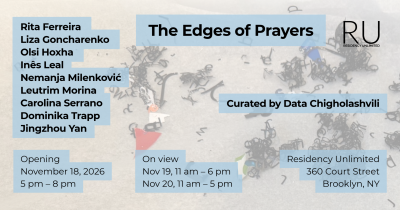
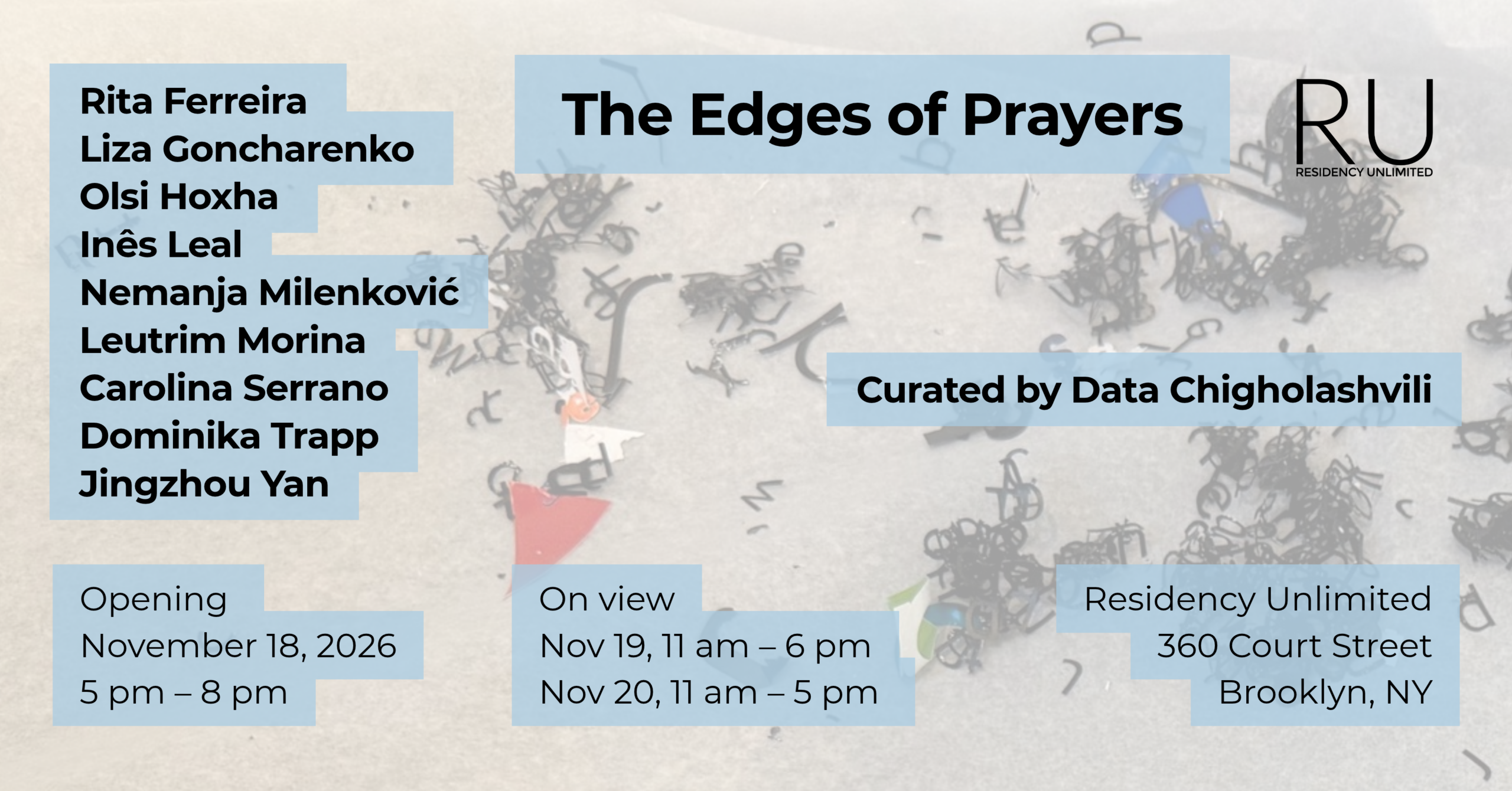
Opening reception: Wednesday, November 18, 2026 | 5:00 pm – 8:00 pm
Performance by Leutrim Morina: Wednesday, November 18, 2026 | 7:00 pm
On view:
Thursday, November 19 | 11:00 am – 6:00 pm
Friday, November 20 | 11:00 am – 5:00 pm
Location: Residency Unlimited, 360 Court Street (main green church doors), Brooklyn, NY 11231 (map)
Please join us for the last group exhibition of 2026, featuring works by international artists from Albania, China, Hungary, Kosovo, Portugal, Serbia, and Ukraine/Belgium. We are proud to present RU resident artists: Rita Ferreira, Liza Goncharenko, Olsi Hoxha, Inês Leal, Nemanja Milenković, Leutrim Morina, Carolina Serrano, Dominika Trapp, and Jingzhou Yan. “The Edges of Prayers” is curated by Data Chigholashvili, Curator of Residency Unlimited.
The title “The Edges of Prayers” echoes “The Edges of Layers,” which was the first group show of the year back in March at RU, inside the former South Congregational Church in Brooklyn. A prayer here has a non-religious connotation; instead, it is seen as an act, a wish, and a tool for meditation on and engagement with the world around us. Presented in a former place of worship, the artworks in “The Edges of Prayers” further take on the role of paying attention to worries or hidden layers across geographies, topics, and senses. The artists in the show respond to these on the edges of inner landscapes, socio-political processes, subjectivities, connections beyond anthropocentrism, and diverse metaphors that emerge throughout the complexity of webs in between. With various forms and ways of expression – sound, word, painting, drawing, textile, photography, and video, across figuration and abstraction – the featured artworks cross paths in symbols and recurring turmoils, as well as in hopes of healing that arise as one moves through the exhibition. In doing so, they become prayers, psychological tools that engage with different urgent questions on personal and collective levels; they dive into human perception, confusion, and connections, including with the non-human world – from organisms to other life forces to machines – and remind us of repetitive patterns, circles, as well as possible breaks and light within.
A new iteration of Olsi Hoxha’s interactive installation series – “Source of Uncertainty” – echoes within the tall arched interior of the former church building. Inspired by cybernetics, chaos theory, and the Lorenz attractor, the artist reuses discarded objects, various materials, and sound equipment to build different versions of this site-responsive work. This piece is activated by the audience’s physical actions and the choices they make within the given structure, making the participants part of chaos and agents of it, and exploring whether order can emerge from it. Using technology to amplify the feedback produced by human interaction, Hoxha’s installation looks at living with uncertainty and improvising while making decisions, highlighting the importance of choice and its ripple effect on the totality within which it is created.
Where sounds are heightened, visitors encounter an artist book “Rage and Paradise” by Inês Leal. The source of archival materials, the newspapers of Minas do Pejão (Pejão Coal Mines, Portugal), conditions the form of this work. The artist decontextualizes archival photographs through careful selection and photo editing. Violence related to mining is addressed in another piece by the artist called “Cannibal Carnival” (referencing Baudrillard’s “Carnival and Cannibal”), projected on the higher level inside the space. The artwork reveals the colonial past of the Portuguese Empire, while presenting rhythmic editing of the 1950s–60s photo archive once used to validate Diamang, a company exploiting Angola’s diamond mines. Together, Leal’s works amplify voices otherwise silent in the archival materials and expose hierarchies between image and text, and those within mining and its destructive effects on people and environments.
Exploring the consequences of human actions on non-human animals, Nemanja Milenković’s installation resembles an investigative board and is part of the series “Gestures of Horror.” The title is derived from Yann Martel’s “Beatrice and Virgil,” where the characters, a donkey and a monkey, utilize physical movements to express deep trauma. The artist examines hunting, poisoning, poaching, and other actions against wild animals, as well as their treatment in zoos and urban contexts. In this rendition, selections from previous series, e.g., “On the European Ground Squirrel,” are combined with new works created during Milenković’s residency and research at the American Museum of Natural History and the Wildlife Conservation Society’s Library & Archives. Works on paper of the ‘evidence board’ are accompanied by an eerie sound, that of a creature, biological or artificial, reminiscent of current landscapes.
Thresholds of inner and outer landscapes emerge in Dominika Trapp’s intuitive paintings made as a form of research. Reminiscent of a hero’s journey, they are meditations on motherhood and responsibility. The female body is at the edge of entering a confined space or stepping into new horizons, either way suggesting a journey of discovery. Connecting to her larger work on traps as a metacritical tool of artistic inquiry, through these pieces Trapp explores how to deal with personal and societal snares and find safety. Placed further on, another work reads: “I am breaking apart like the world.” It references a line from Sylvia Plath’s “Three Women: A Poem for Three Voices,” read as a critique of external control over the female body and fertility. In doing so, the artist questions what it means to bring life into the current world in climate, social, and economic crises.
Societal pressures are central to Leutrim Morina’s work called “To Hear the Flower Cry.” The title comes from a traditional Albanian song – “këngë kanagjegji” – performed by women during the pre-wedding henna night. While referencing this tradition, the artist reminisces about experiences of growing up in Kosovo, particularly how listening to traditional songs or rap music was considered acceptable for a boy, but liking pop divas was frowned upon. Morina’s work is an attempt to come to terms with a past of limiting expression and of taking on domestic responsibilities from a very young age. The painting is an homage to his mother and her hard work of bringing up a family, and a reminder of the warmth he missed as a child. In front of it, the artist performs his own rite of passage and dances away the worries to the songs he secretly admired.
Jingzhou Yan’s paintings depict cartoonish characters, plasticine-like figures that often appear in everyday contexts, yet somewhat on the verge of unease and glee. Frequently referencing elements from films, television, and pop culture, the artist chooses dark humor to respond to the generational anxiety in today’s world. The work on view is from a series that explores prayer not in religious terms but in relation to the externalization of worries and devotion. The large paintings from this group depict single figures covering almost the entirety of the surfaces, bowing to small flowers in front of them. As in Yan’s other works, the scene in the featured work is intentionally ambiguous and humorous, revealing vulnerability and confusion, making us think of praying, obeying, and symbols of dedication.
Liza Goncharenko focuses on the revival of Ukraine’s ecosystems amid Russia’s full-scale invasion. “Cartographies of Care” is a collectively embroidered map of Ukraine, resulting from a student workshop in Antwerp, Belgium. It shows the country’s biodiversity, endangered species, and protected natural areas, as well as the invasion line. “Tracing the Unseen” is an imaginary take on the future of the Zhuravlivka urban forest in the artist’s hometown, Kharkiv. A shelling-caused fire entirely destroyed the ecosystem of the forest, which also used to be an important recreational space for the local community. “The Earth Is Burning” is a collaborative artist book responding to the ecocide in Ukraine, exploring what happens to rivers, woods, agricultural lands, and other sites of natural and collective memory. As the devastating results of the invasion continue, Goncharenko addresses destructive consequences of war for various beings and imagines a future of recovery.
Rita Ferreira is interested in the transformation and perception of images across materials and contexts of representation. Exploring boundaries between figuration and abstraction through painting, she fragments and reorganizes various types of visuals in order to examine how images emerge and become [un]recognizable. In her recent inquiry, the artist looks at how an ambiguous composition can turn into a recognizable image. She contemplates apophenia – our tendency to ascribe meaning to seemingly unrelated forms or events – together with the 1890s–1900s work of Arthur Mason Worthington, who experimented with photography capturing moments of liquid drops touching surfaces. Through fluidity and layering in her paintings, Ferreira invites viewers to consider how the materiality of liquid can affect images, and how their representation and understanding can influence engagement with the world around us.
Light, cyclicality, division, and healing are explored in Carolina Serrano’s installation. In “The Zinc Spark” series, the artist expands metaphors and meanings from observations on an atomic level – the zinc spark is a phenomenon in which zinc ions burst from an egg at the very moment sperm fertilizes it, producing a flash of light visible under the microscope with the help of fluorescent dye. Utilizing a scientific micrograph that also resembles a celestial body, in this rendition, Serrano divides the visual representation in half, alluding to antagonisms around us. The two complementary images are placed in the corner of the room, as if almost impossibly gravitating towards each other, trying to reconnect. The divided image of the spark is united by a projection of a luminous circle over it, a reminder of both repetitive patterns and of possibilities for restoration and healing.
About:
Rita Ferreira’s artistic practice occupies an ambiguous space within the field of representation, between figuration and abstraction. She works from concrete references, often associated with belief systems or objects drawn from historical, scientific, or everyday contexts, using them as points of departure to question painting as a language. The image is not understood as a representation to be preserved, but as something that is transformed and reorganized as a pictorial structure. Her work develops mainly through oil on paper, drawing, and installation. The works are often organized in series, groups, or display systems, in which the relationship between image, physical medium, and scale takes on a central role.
Liza Goncharenko is a Ukrainian architect, urban designer and researcher at the Royal Academy of Fine Arts Antwerp. During 2013–2017, she was Ukraine’s National Contact for the EASA (European Architecture Students Assembly), later tutoring at EASA Tourist (Switzerland), EASA Rhizome (Finland), EASA Seanchaí (Ireland) and IDW Antwerp (Belgium). She co-curated SESAM (Small European Students of Architecture Meeting, 2021), a month-long international architecture event within the EASA network held in Slavutych, Ukraine – bringing together over 100 participants from more than 20 countries, focused on the theme ‘Poliklinika’ (clinic), exploring healthcare and its relationship to architecture, alongside lectures, discussions, performances, music events, and visits to the Chornobyl Exclusion Zone. Her work explores architecture, heritage, and landscape, with a focus on Ukraine’s reconstruction.
Olsi Hoxha – the recipient of the 2025 Ardhje Award for young visual artists in Albania – is an interdisciplinary artist whose practice spans materials, disciplines, and technologies, including electroacoustic sound sculptures, video art, collage, photography, installation, and circuit bending. He moves between the technical and the poetic, working with found objects, obsolete technologies, and discarded media to reflect on how technological, social, and personal systems shape perception, behavior, and meaning. His work is informed by cybernetics, chaos theory, and technological nostalgia, exploring how feedback—both literal and metaphorical—shapes the world: how small actions ripple through systems, how randomness coexists with structure, and how control and collapse blur. Using thrown-away materials such as old electronics, broken devices, and forgotten images, he creates interactive works that function as a form of urban archaeology. His projects invite public participation and emphasize glitch aesthetics, instability, play, and open-ended processes.
Inês Leal is a visual artist, researcher, and designer. Her artistic and research practice has an essayistic and experimental character, resulting in the production of installations, series of works in video, photography, or other analog technical media, where she regularly resorts to the appropriation and study of photographic archives. During her master’s degree in Cinema, she conducted research into working communities in mining regions and their relationships with the moving image. She has been producing and exhibiting artworks regularly in exhibition contexts since 2021, having shown her work collectively at Culturgest Porto, Centro Internacional das Artes José de Guimarães (CIAJG), gnration, Galeria Municipal do Porto, Serralves Museum, and La Casa Encendida (Madrid, Spain).
Nemanja Milenković – the winner of the 2025 Dimitrije Bašičević Mangelos Award – explores the relationships between humans and non-human animals, which he understands as existing along a spectrum between two extremes: the radical exploitation of non-human animals and their radical protection. He creates layered installations that incorporate drawing, painting, readymade objects, and performance, seeking to understand processes of coexistence with nature through discipline and collaboration in artistic practice. Alongside his individual practice, he is a member of the renowned art group Led Art, founded by Nikola Džafo in 1993.
Leutrim Morina – the winner of the Artists of Tomorrow Award 2025 organized by Stacion CCA in Pristina – reflects on his personal experiences and cultural background, and works across painting, performance, video, and photography. He uses artistic means to influence the perception of viewers and bring about positive change. Leutrim uses humor and irony to make complex and often difficult topics more accessible. At the same time, he strives to evoke a sense of calm and reflection in people. His projects and artworks explore the tension between life’s challenges and the possibility of recognizing the good, where he wants to show that, regardless of difficulties, there is room for hope, creativity, and positive transformation. His practice explores themes of freedom, expression, justice, memory, and trauma. Leutrim uses diverse forms and techniques to create experiences that provoke reflection, spark curiosity, and inspire resilience. His art is both personal and universal, connecting individual histories with shared human struggles, emphasizing that creativity and courage can transform life and offer hope.
Carolina Serrano’s work and research revolve around the temporal dimensions and dematerialization of sculpture, and the attempt to understand what it means to be human by exploring opposing concepts such as good/evil, inside/outside, freedom/confinement, violence/innocence, light/shadow. She works mainly with wax, as this material comes closest to the temperature and texture of human skin, and because of the theoretical and conceptual possibilities that this material can originate in the field of the observer’s imagination. The exploration of duality and the antagonisms of existence is manifested in the artist’s work through the creation of a place that exists between binaries, in other words, a place-limbo, or a place-between. The concept of ‘being in-between’ – which is linked to the attempt to define what it means to be human – is fundamental to Serrano’s work, as the exploration of this ‘in-between space’ is what she looks for to embody through her practice.
Dominika Trapp’s artistic practice unfolds across three interconnected fields: intuitive painting, collaborative projects engaging with grassroot cultural histories, and museological interventions. In her individual work, she approaches intuitive painting as somatic praxis and artistic research – exploring the body as a ground of emancipation, embodied knowledge as a moral compass, and women’s agency within peasant culture. Parallel to this practice, she develops collaborative projects outside conventional contemporary art contexts, engaging with houses of culture in the Hungarian countryside, and the Hungarian dance-house movement through field research and collaborations with communities. Another strand of Trapp’s work involves artistic interventions in archives. Her doctoral research emerged from work with the trap collection of the Museum of Ethnography in Budapest, where she interprets the trap as a metacritical tool for examining institutional and methodological constraints within artistic research itself.
Jingzhou Yan’s recent body of work revolves around the ongoing project “Buster”, a fictional yet reflective world that examines the absurdities and emotional contradictions of contemporary life. Through the figure of “Buster”—a recurrent alter ego who shifts between humor and melancholy—he explores how images, desires, and technologies construct our perception of reality. The project functions as both a psychological map and a painterly experiment, where the boundary between the personal and the collective constantly dissolves.
This exhibition program is supported by the Trust for Mutual Understanding, Flanders State of the Art, Shuttle Programme — PLÁKA Platform, Porto City Council, FLAD – Luso-American Foundation for Development, Calouste Gulbenkian Foundation and Kisterem Gallery.






This program is supported, in part, by public funds from the New York City Department of Cultural Affairs in partnership with the City Council. In-kind support is provided by Materials for the Arts.