October Open Studio at RU House on Governors Island
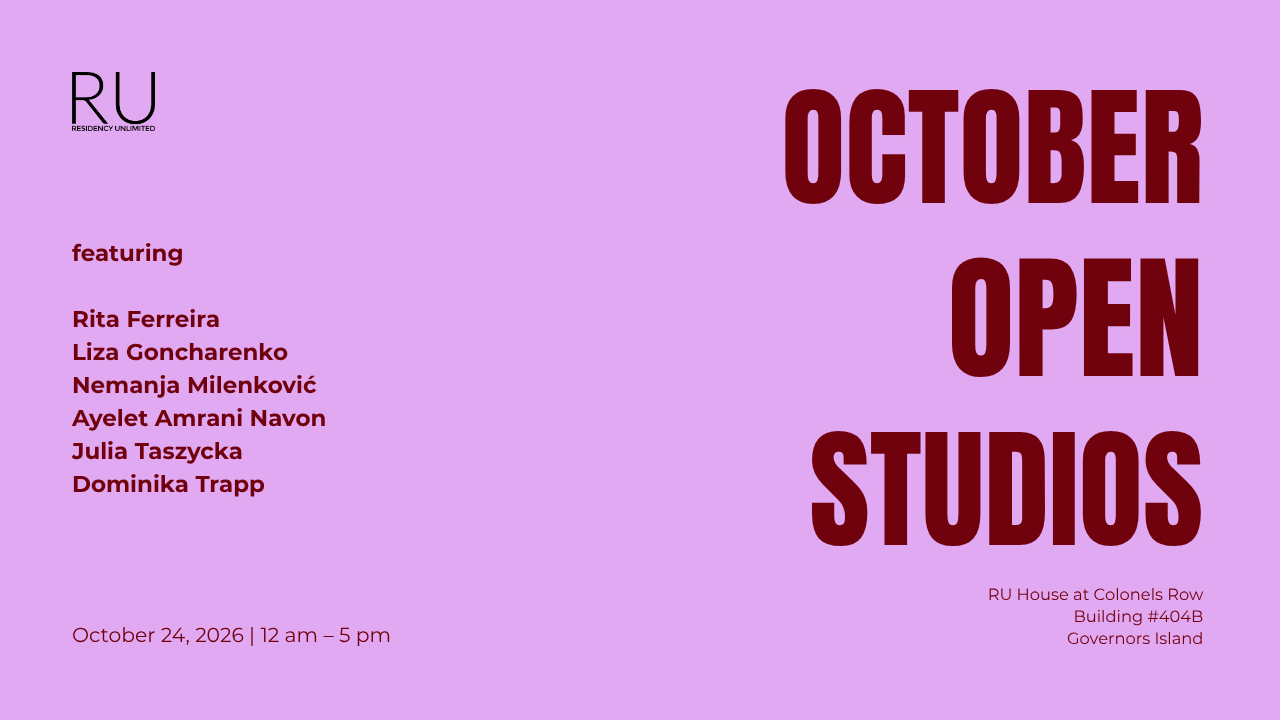
October 24, 2026 | 12 – 5pm
Location: RU House at Colonels Row, Building #404B on Governors Island (map)
Ferry information | Video directions
On October 24, we warmly invite you to visit the RU House on Governors Island for a day of open studios. As part of the 2026 Organizations in Residence program, RU has a presence at the RU House at 404B Colonels Row from May through October, where RU artists and alums have studio spaces to develop new bodies of work across the 2026 season. On this day Rita Ferreira, Liza Goncharenko, Nemanja Milenković, Ayelet Amrani Navon, Julia Taszycka, Dominika Trapp will open their studios to the public, offering a rare opportunity to engage with their creative processes and discover works in progress firsthand.
Governors Island is open to the public with free ferry rides before 11am on weekends — we hope you will join us and make a day of exploring the Island!
About:
Rita Ferreira’s artistic practice occupies an ambiguous space within the field of representation, between figuration and abstraction. She works from concrete references, often associated with belief systems or objects drawn from historical, scientific, or everyday contexts, using them as points of departure to question painting as a language. The image is not understood as a representation to be preserved, but as something that is transformed and reorganised as a pictorial structure. Her work develops mainly through oil on paper, drawing, and installation. The works are often organised in series, groups, or display systems, in which the relationship between image, physical medium, and scale takes on a central role
Liza Goncharenko is a Ukrainian architect, urban designer and researcher at the Royal Academy of Fine Arts Antwerp. During 2013–2017, she was Ukraine’s National Contact for the EASA (European Architecture Students Assembly ), later tutoring at EASA Tourist (Switzerland), EASA Rhizome (Finland), EASA Seanchaí (Ireland) and IDW Antwerp (Belgium). She co-curated SESAM (Small European Students of Architecture Meeting, 2021), a month-long international architecture event within the EASA network held in Slavutych, Ukraine – bringing together over 100 participants from more than 20 countries, focused on the theme ‘Poliklinika’ (clinic), exploring healthcare and its relationship to architecture, alongside lectures, discussions, performances, music events, and visits to the Chornobyl Exclusion Zone. Her work explores architecture, heritage, and landscape, with a focus on Ukraine’s reconstruction. During her residency at RU, Liza will expand Landscapes of Recovery, a long-term project examining environments shaped by war, fire, and extraction as ecological and cultural archives. Focusing on sites in Ukraine affected by Russia’s invasion, burned forests, and damaged river systems, she approaches these not as isolated cases but as part of broader planetary conditions shaped by conflict and uneven repair.
Nemanja Milenkovićis the winner of the 2025 Dimitrije Bašičević Mangelos Award. In his practice he explores the relationships between humans and non-human animals, which he understands as existing along a spectrum between two extremes: the radical exploitation of non-human animals and their radical protection. He creates layered installations that incorporate drawing, painting, readymade objects, and performance, seeking to understand processes of coexistence with nature through discipline and collaboration in artistic practice. Alongside his individual practice, he is a member of the renowned art group Led Art, founded by Nikola Džafo in 1993.
Ayelet Amrani Navon explores themes of transience and intimacy. Contemplating what it means to be human, in a human body, and what it means to encounter another. She focuses on painting, sculpture and participatory installations that contain “a place to meet”, environments where human connection can be amplified and experimented with. These environments are the sites of one-to-one encounters where she is bodily present with a participant and through which she attempts to achieve a person-to-person reaction. She uses voice, sensory stimulation and principles of psychoanalytic theory. Growing up questioning the idea of attachment to land, alongside a perpetual sense of wandering, she explores forms of belonging and intimacy in circumstances of transition, impermanence, and change. Her work was presented mainly in not-for-profit spaces, such as artist-run, municipal and museum venues.
Julia Taszycka’s work shows what society no longer wants to look at. Old, used, and dirty building materials, destined for disposal, become the subject of her consideration. These objects, due to their lack of reusability, fit perfectly within the context of art, having already lost their original function and therefore become abstract objects. Taszycka strives to limit the artist’s gesture as much as possible, preserving the inherent aesthetics of the objects. Therefore, her practice focuses on the social narrative rather than artistic intervention and aestheticization. She is interested in the issue of the “troublesome legacy” of capitalist material culture, working on discarded and recycled elements found on the streets of New York and other cities. Taszycka comes from a post-socialist country, fascinated by capitalism. Since she is the first generation born and raised in free-market Poland, working with byproducts of systemic exploitation represents a deconstruction of myths and hopes fortified by neoliberalism.
Dominika Trapp‘s artistic practice unfolds across three interconnected fields: intuitive painting, collaborative projects engaging with grassroot cultural histories, and museological interventions. In her individual work, she approaches intuitive painting as somatic praxis and artistic research – exploring the body as a ground of emancipation, embodied knowledge as a moral compass, and women’s agency within peasant culture. Parallel to this practice, she develops collaborative projects outside conventional contemporary art contexts, engaging with houses of culture in the Hungarian countryside, and the Hungarian dance-house movement through field research and collaborations with communities. Another strand of Trapp’s work involves artistic interventions in archives. Her doctoral research emerged from work with the trap collection of the Museum of Ethnography in Budapest, where she interprets the trap as a metacritical tool for examining institutional and methodological constraints within artistic research itself.
This program is supported, in part, by public funds from the New York City Department of Cultural Affairs in partnership with the City Council. In-kind support is provided by Materials for the Arts.

RU is grateful for the partnership with Governors Island Arts.