Opening: October 17, 2026 | 11:00 am – 5:00 pm
On view: October 17-18, 24-25, 2026 | 11:00 am – 5:00 pm
Weekday visits by appointment
Location: RU House at Colonels Row, Building #404B on Governors Island (map)
Ferry information | Video directions
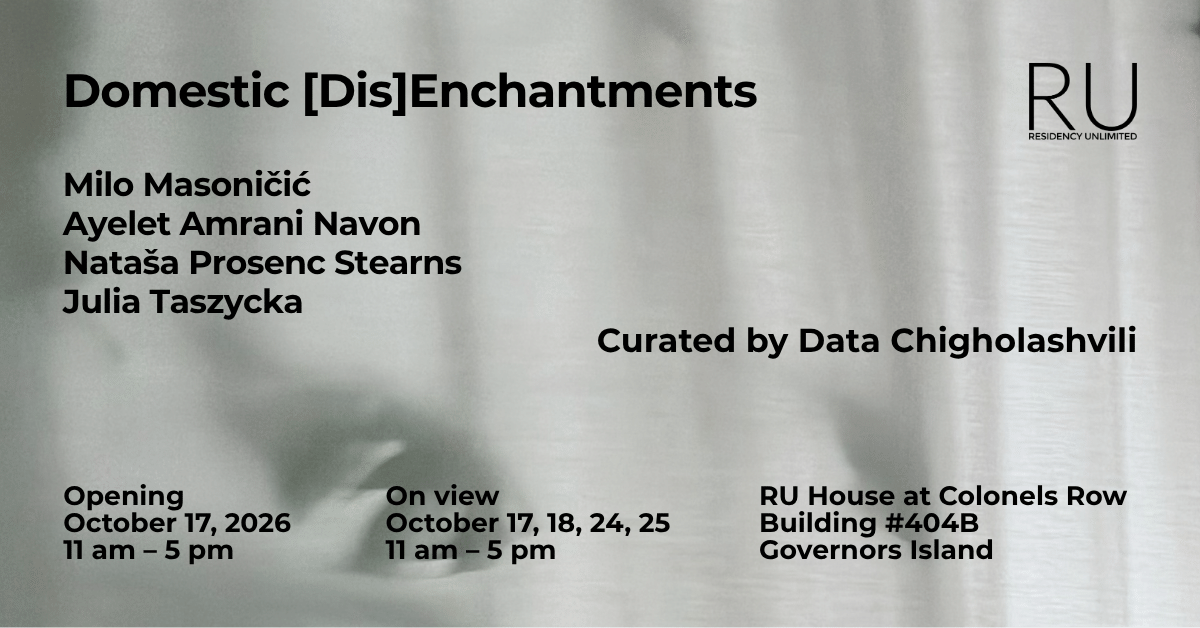
To complete the 2026 exhibition season at the RU House on Governors Island, please join us for the group show “Domestic [Dis]Enchantments” featuring works by RU resident artists – Milo Masoničić, Ayelet Amrani Navon, Nataša Prosenc Stearns, and Julia Taszycka.
Curated by Data Chigholashvili, Curator of Residency Unlimited, this exhibition carries forward meditations on domestication, house, home, and body. These themes were variously addressed across other exhibitions of the season at the RU House – Domesticated; Living Room Portfolio: Enchanted House; Home, Wound, Growing; and Something’s Glitching in the House.
“Domestic [Dis]Enchantments” focuses on transformation and its different aspects, and [de]mystifies this former residential house through installations, moving images and objects, songs and sounds – offered as metaphors for the bodies and homes we inhabit. [Dis]enchantment here conceptually plays at the intersections that emerge between liminal spaces, subconscious, bodies, objects, and metamorphosis. It also invokes the term as theorized in the social sciences, largely after Max Weber, for the modern tendencies to explain the world around us primarily through rationalization. Together, the works featured invert meanings, turn things inside out or upside down, glitch or transform images and objects, and reach toward what might be concealed or hidden in plain sight. In doing so, they invite us to think about our different abodes – homes, bodies, memories, structures – and what they tell us about ourselves, our surroundings, and how we move through them.
Investigating the blurring of boundaries between different media and meanings, Nataša Prosenc Stearns presents an immersive installation about body, home, and subconscious. Her work centers on the female body and often references elemental forces, particularly water, present in this piece as well. We hear water and see a woman swimming in the house, but cannot tell whether she is enjoying the moment of freedom or drowning and asking for help, just as we cannot tell whether the sound of falling drops is coming from the island or from somewhere in the house. Playing with perception is an intentional tool for Prosenc Stearns when transforming different environments. In enchanting this house, she shows a flower that may not be what it seems: a body that changes, a host of the house, or a house that hosts. Similarly, the hangers that seem to have escaped one of the closets and gathered in another room read as an eerie metaphor, or a sign of reorganizing and refreshing. Through these gestures, the artist creates an alphabet of symbols that seem familiar but that we have a hard time understanding or putting into words.
Ayelet Amrani Navon restages a bedroom in the house, though in a liminal condition – dimmed, before night falls – symbolizing a portal and a transitional moment between being awake and sleeping. In doing so, she also recalls lullabies – those sung to her as a child, and later, those she whispered as a mother to lull her children – recreating the intimate spaces and moments where and when bonds are forged between children and their caregivers. In addition to domestic textiles one often encounters in a bedroom, the artist presents an embroidered fabric with Yemeni stitching and cowry shells, referencing her own mixed heritage and personal memories. Echoing the mysterious elements that often exist in lullabies, a clock without hands and a metronome measuring time with sound are also found in the bedroom. Somewhere in the house, lullabies are heard, like those distant memories of childhood. They are part of a growing lullaby archive, inspired by Amrani Navon’s early memories of bedtime songs in Hebrew, Ladino, and English (American). As part of this ongoing project, she invites visitors to contribute their reminiscences of bedtime sounds, or just to participate in one-on-one sessions of lullaby-singing and contemplation – register here for a session.
In her practice, Julia Taszycka is interested in working with human-made objects that are worn-out, no longer functional or wanted, often those associated with buildings, cars, or domestic items. The flat-oval HVAC ducts of galvanized steel, pipe-like channels used to route heated or cooled air through the walls of office or residential buildings, have been discarded, discovered, and transformed into an installation in a space that used to be a living room. Through her work, Taszycka offers critical commentary on the burdensome consequences of capitalist material culture and questions how objects, including those of the art world, become commodified and fetishized. Though sited in a house from a different era, her installation still places the inside of a structure on display – an action that, more broadly, characterizes her conceptual practice, where she critically engages with the abovementioned objects, reads them as physical records of larger socio-economic processes, turns them into readymades, and reveals hidden tensions around labor or urban change. Set up in a former residential house on a calm island that is part of NYC, a global metropolis, the work disenchants the transformation of urban fabric in the face of rapid modernization and demolition that accompanies it in many places, and recalls what remains on the margins.
Focused on sampling in his practice, Milo Masoničić presents video works on bodies and transformations where meanings change as much as forms, and structures and power hierarchies become inverted. In “Tenderness” (2025), we see a slow passage of bodies as extended glitches, yet at first cannot tell whether they are confronting or embracing each other. Through the editing and slit-scanning of Soviet-era archival footage of Greco-Roman wrestling intended for martial training, the artist shifts the agency of the propaganda videos imbued with ideas of power, combat, hierarchy, and domination. The resulting artwork deliberately strips away aggression and fighting inherent to the material, and transforms the bodies in the footage – making them more vulnerable, sensual, erotic, and dependent on each other rather than defeating the other. Another video, “Rats and Cats” (2025), looks at becoming the other, with prey turning predator, approaching identity as fluid and ever-changing. Here Masoničić’s use of AI-generated footage comments on the subtleties and fragility accompanying rapid change. Both videos utilize sound layering, making the viewing experience whimsical or surreal, with images moving in their own time and world. Together, they invite visitors to contemplate bodies and homes – the underlying structures, memories, and external forces that shape and re-shape them.
About:
Milo Masoničić is the recipient of the 2025 Milčik Award for Young Visual Artists in Montenegro. Sampling sits at the core of his practice, functioning both as a tool and as a way of perceiving the world. His work spans experimental film, video, sound, and digital media, drawing on processes of montage, appropriation, archiving, and remixing. By working with fragments displaced from their original narratives, Masoničić constructs new visual and digital landscapes from materials that are already familiar or recognizable. Recurring motifs from different sources are layered and reassembled, creating rhythm through irregular loops that partially repeat while subtly shifting with each iteration. Although the materials and methods vary, Masoničić’s practice consistently returns to themes of childhood, time and aging, nature, and technology, exploring the fragile relationships between memory, repetition, and transformation.
Ayelet Amrani Navon explores themes of transience and intimacy. Contemplating what it means to be human, in a human body, and what it means to encounter another. She focuses on painting, sculpture and participatory installations that contain “a place to meet”, environments where human connection can be amplified and experimented with. These environments are the sites of one-to-one encounters where she is bodily present with a participant and through which she attempts to achieve a person-to-person reaction. She uses voice, sensory stimulation and principles of psychoanalytic theory. Growing up questioning the idea of attachment to land, alongside a perpetual sense of wandering, she explores forms of belonging and intimacy in circumstances of transition, impermanence, and change. Her work was presented mainly in not-for-profit spaces, such as artist-run, municipal and museum venues.
Nataša Prosenc Stearns is a visual artist and filmmaker working in the field of expanded moving image, dissolving the boundaries between film, video, print, sculpture, and installation. Her formative years unfolded amid the social and political upheavals of Eastern Europe—wars, dislocations, and cultural transformations that eventually led her to relocate to the United States. These experiences continue to shape her work, which explores psychological landscapes of displacement, memory, identity, and the alienation of contemporary life. Drawn to the mysterious and the unknown, she often works with dreams, myths from her native Slovenia, and phenomena that resist explanation or language. Visually, her practice is marked by an interest in the materiality of the body, the elemental force of water, and immersive multi-channel installations, often created for unconventional and non-gallery spaces.
Julia Taszycka’s work shows what society no longer wants to look at. Old, used, and dirty building materials, destined for disposal, become the subject of her consideration. These objects, due to their lack of reusability, fit perfectly within the context of art, having already lost their original function and therefore become abstract objects. Taszycka strives to limit the artist’s gesture as much as possible, preserving the inherent aesthetics of the objects. Therefore, her practice focuses on the social narrative rather than artistic intervention and aestheticization. She is interested in the issue of the “troublesome legacy” of capitalist material culture, working on discarded and recycled elements found on the streets of New York and other cities. Taszycka comes from a post-socialist country, fascinated by capitalism. Since she is the first generation born and raised in free-market Poland, working with byproducts of systemic exploitation represents a deconstruction of myths and hopes fortified by neoliberalism.
This exhibition program is supported by the Trust for Mutual Understanding, Artis, and the Ministry of Culture and National Heritage Republic of Poland – Adam Mickiewicz Institute.



This program is supported, in part, by public funds from the New York City Department of Cultural Affairs in partnership with the City Council. In-kind support is provided by Materials for the Arts.

RU is grateful for the partnership with Governors Island Arts.