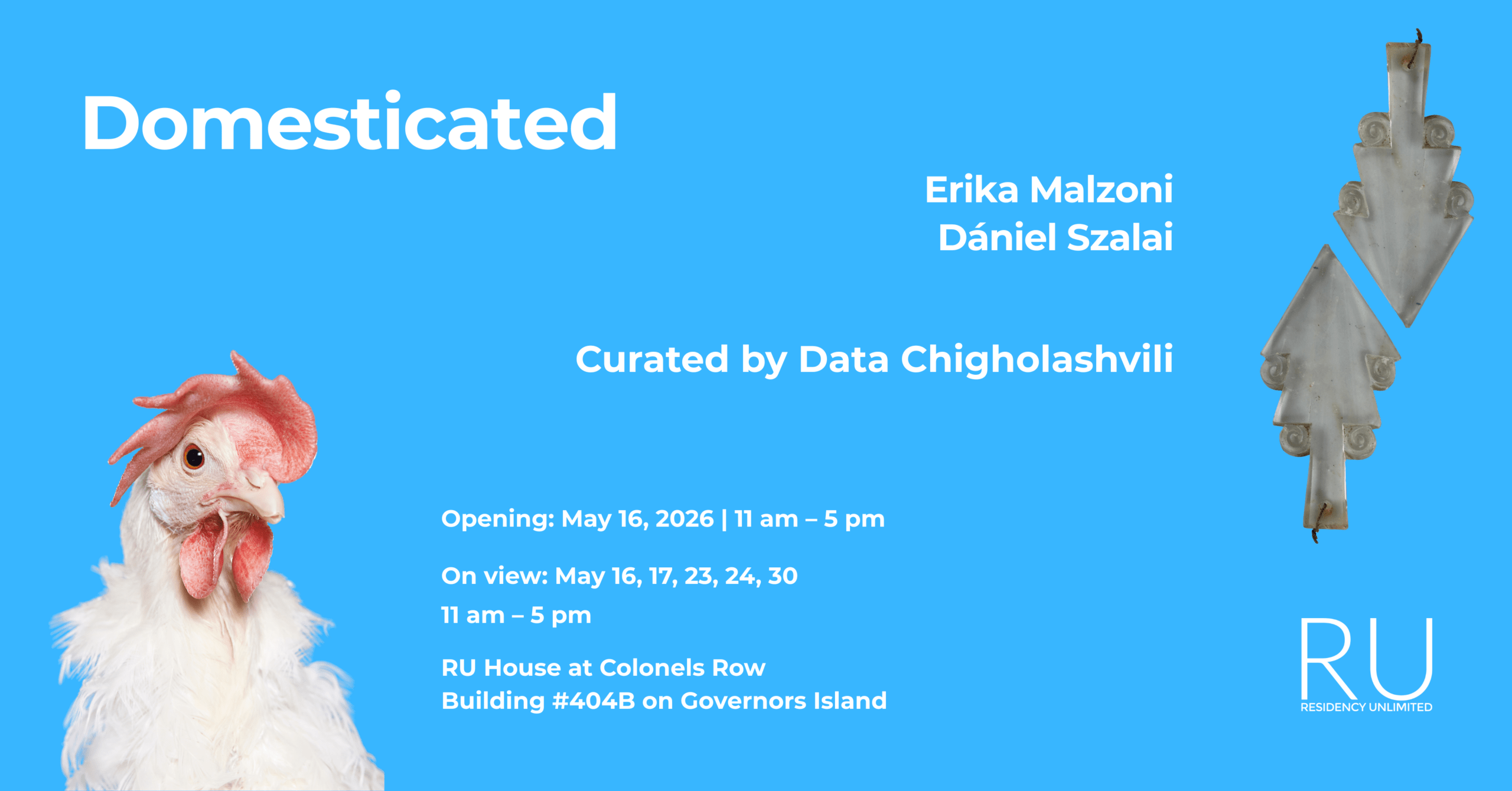
Opening: May 16, 2026 | 11 am – 5 pm
On view: May 16, 17, 23, 24, 30 | 11 am – 5 pm
Weekday visits by appointment
Location: RU House at Colonels Row, Building #404B on Governors Island (map)
Ferry information | Video directions
Please join us for our first group exhibition of the 2026 season at the RU House on Governors Island, featuring works by RU resident artists: Erika Malzoni and Dániel Szalai. “Domesticated” is curated by Data Chigholashvili, Curator of Residency Unlimited.
To Domesticate: “to bring animals or plants under human control in order to provide food, power, or company” – reads a definition in the Cambridge Dictionary. Perhaps one of the most extreme examples of domestication is the silkworm (Bombyx mori). While this is not the oldest species subjected to human control, over 5,000 years of domestication resulted in these insects having lost the ability to fly, camouflage, and find food – entirely depending on humans for survival. This exhibition does not include direct references to silkworms, but the conceptual background is strongly informed by sericulture and its metaphors, which will most likely emerge in curatorial walkthroughs by Data Chigholashvili taking place on May 16, 11:00 AM – 5:00 PM.
“Domesticated” features works of two RU resident artists, Erika Malzoni and Dániel Szalai. By bringing together their distinctive themes and approaches, the exhibition explores interconnections between domestication and classification, questioning anthropocentrism and how far it can stretch. Having roots in Latin domus (house, home, household), domestic and domesticate take another conceptual layer in the context of this show set in a former residential house on an island, which itself was once turned into a military base and then decommissioned into a public recreational space. Researching socio-political ecology surrounding domesticated animals, Dániel Szalai questions the boundaries of human control over other living beings around us. Its related taxonomy and classification are also central, though in a different way, to Erika Malzoni’s practice, which exposes invisible connections with human-made materials and objects. Together, these works invite visitors to explore our relational patterns towards animate and inanimate worlds, hence, think about human need – and the limits thereof – to classify, control, accumulate, and utilize. Also, in the spirit of the famous “chicken and egg” problem, the exhibition ponders the question of what came first: classification or domestication?
Dániel Szalai presents various pieces from three projects inquiring at the intersection of domestic animals, human agency, and technology. From “Novogen” (2017–2018), we see a selection from 168 seemingly indistinguishable yet individual portraits of white chickens, belonging to highly specialized egg-laying hens under the same name. Together with documentation of their eggs being used in the pharmaceutical industry for vaccine production, these birds also become metaphors for their domesticators, whose individuality and needs often disappear in the face of mass industrialisation. “Unleash Your Herd’s Potential” (2019–2022) investigates PLF (Precision Livestock Farming), where, much like other fields of life today, technology and algorithms provide data-driven solutions. The artist explores how surveillance capitalism extends to animals, which are perceived as datasets. Utilizing photogrammetry, 3D scanning achieved through photographic images, he subverts romanticized rural or natural scenes in the digital age. A similar approach emerges in a somewhat industrially idyllic video piece called “Technominotaur” (2023-2026). A CNC (Computer Numerical Control) machine meditatively carves a metal block, repeating a shape licked into salt blocks by captive bulls at artificial insemination centers, while we hear an ambiguous sound belonging to an animal or a machine.
The complexity of human relationships with the environment emerges in Erika Malzoni’s site-specific work called “encounters”, which is inspired by her having a studio at the RU House on Governors Island. Spread throughout the former residential house, this installation comprises domestic and found objects, as well as a text-based intervention. While observing her surroundings, the artist explores structures, patterns, and belonging. Carefully arranged materials and objects rethink the threshold between the notions of house and home, and the roles of their makers. In this exhibition on the island in the New York Harbor, she also focuses on water. Containers of different sizes, shapes, and functions are organized into streams and confluences throughout the house. The artist emphasizes the critical importance of this natural resource and how human attempts to contain, control, and use water affect the environments we inhabit. It also reminds us about the diversity of perceiving animate and inanimate worlds, much like rivers can belong to either depending on scientific, cultural, or linguistic contexts. Furthermore, using language and translation, Erika Malzoni utilizes caution tape message “CUIDADO” – Portuguese for being careful or taking care, reminding us of fine lines in our relationship with nature.

Click above to see the exhibition photos.
Click below to see the exhibition video
About:
Erika Malzoni is a Brazilian visual artist working across sculpture, installation, and text-based interventions. Her practice mobilizes everyday materials – ceramics, textiles, mirrors, packaging, and found objects – to interrogate structures of visibility, value, and belonging. Treating language as both medium and material, she activates public and intimate spaces through subtle gestures of repetition, displacement, and accumulation. Her work often reveals the invisible networks that connect people, objects, and everyday life. Before dedicating herself fully to visual arts, she studied data processing and later completed a Postgraduate Certificate (Lato Sensu) in Systems Analysis at FAAP – Fundação Armando Alvares Penteado in São Paulo (1988), an early formation that resonates with her ongoing interest in relational structures, networks, and patterns of connection in everyday life. She has maintained an independent visual arts practice since 2009.
Dániel Szalai is a Hungarian visual artist and researcher. His work explores the relationship between humans and animals, reflecting on social, political and ecological anomalies. Due to the burdens of our shared technobiopolitical reality, domesticated animals play a central role in Szalai’s work. By examining how we treat these animals, he seeks to address not only our relationship with nature, but also to question what it means to be subjected to human systems of control and, in doing so, to challenge the status quo. In recent years, Szalai has focused on intensive dairy farming and precision agriculture. Using the modern dairy cow as a paradigm of contemporary civilization, he has investigated the various technologies that capitalism uses to exploit the reproductive functions of non-human females. His most recent work addresses the invisible labour of breeding bulls in industrial animal husbandry, examining themes of masculinity, monstrosity and domestication.
This program is supported by the Trust for Mutual Understanding.

This program is supported, in part, by public funds from the New York City Department of Cultural Affairs in partnership with the City Council. In-kind support is provided by Materials for the Arts.

RU is grateful for the partnership with Governors Island Arts.