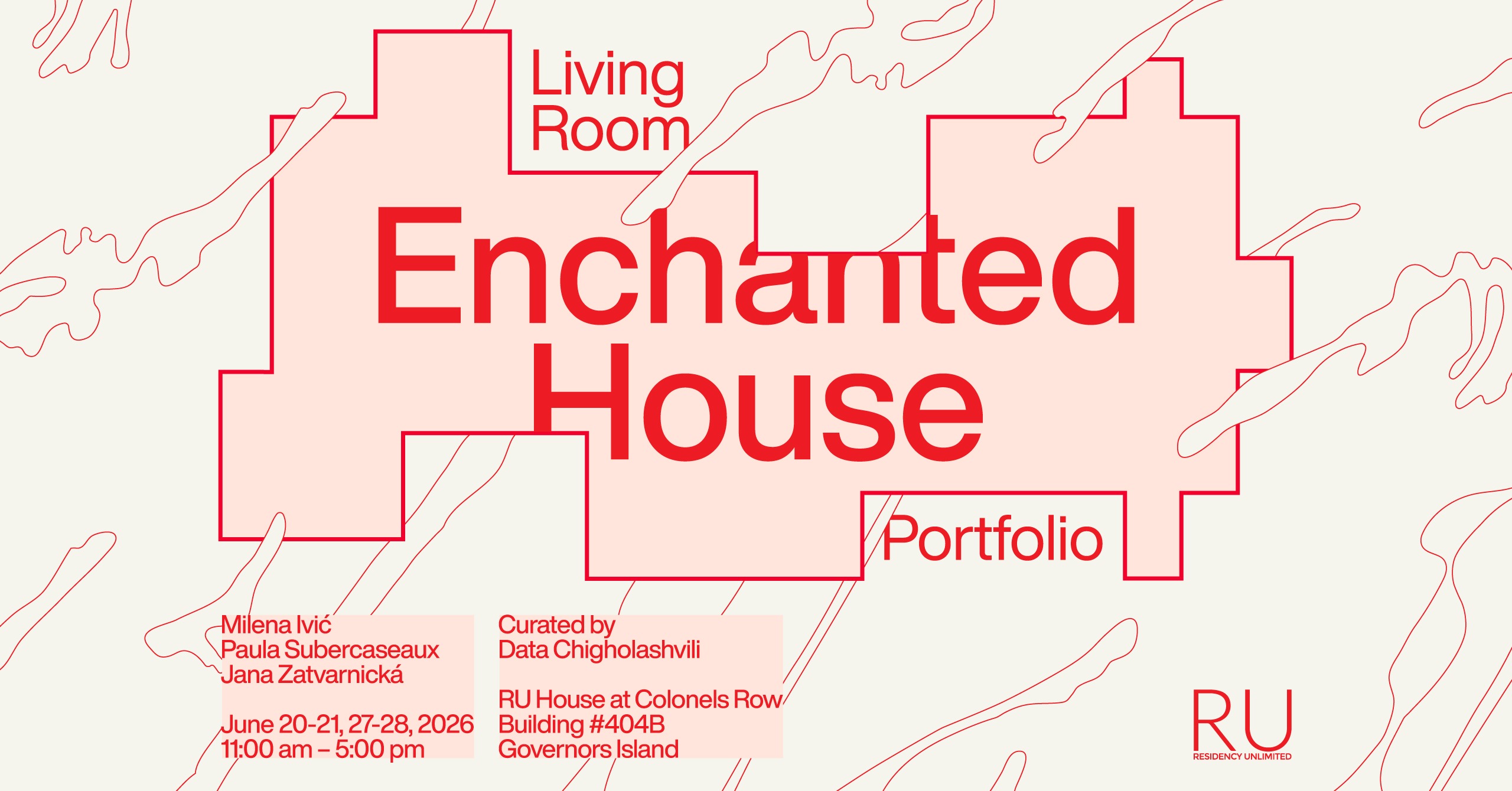
On view: June 20-21, 27-28, 2026 | 11:00 am – 5:00 pm
Weekday visits by appointment
Location: RU House at Colonels Row, Building #404B on Governors Island (map)
Ferry information | Video directions
Please join us for the weekends of artistic interventions by RU resident artists, Milena Ivić, Paula Subercaseaux, and Jana Zatvarnická at the RU House on Governors Island. Curated by Data Chigholashvili, Curator of Residency Unlimited, “Enchanted House” is the fourth edition of “Living Room Portfolio” – an experimental exhibition format that reflects on residencies as experiences of exchange, and incorporates an open studio format. While showcasing artworks throughout the house, the artists and the curator will also be temporary “hosts” in the space, creating possibilities for engagement and discussion.
Don’t miss the opportunity to visit the house to meet the “hosts” and see the works on select days:
June 20-21 / Milena Ivić, Paula Subercaseaux
June 27-28 / Milena Ivić, Jana Zatvarnická
June 20 and 28 / Curatorial walkthroughs by Data Chigholashvili
“Living Room Portfolio: Enchanted House” continues meditations on interconnected topics of body and home, and brings together artworks with strong female perspectives. Creating a somewhat mysterious atmosphere in this former residential house, the works rethink the notion of home – as a physical structure, as a body, or on the move, transcending through different memories and emotions, as well as being a safe place or one devoid of the sense of security. The house on the island becomes enchanted with the exhibition that interplays with different connotations of this very word, suggesting that comfort and protection associated with home can also change when subjected to external forces. “Living Room Portfolio: Enchanted House” ponders how separate entities can belong together and how collectivity can become an obstacle or even unsafe. It also looks beyond anthropocentrism, thinking about variations of bodies and homes – vessels devoid of additional decorations, or those morphing with nonhuman forms. Together, the works remind us of our desires to belong, shelter, and become through different memories, bodies, and homes.
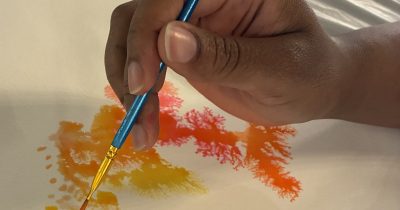
Various dots and forms flow in different trajectories, leaving traces on the paintings and sculptures by Paula Subercaseaux. Her works are meditations on movement and thought processes, which alter in the making, and seek light in the darkness. During her residency, at her studio at the RU House on Governors Island, Subercaseaux made new monochromatic watercolor paintings with predominantly natural pigments. Created by the flow of watercolors on different types of papers, these works can be perceived as either a close-up of a skin, a protective layer, scales, or a broad view of singular bodies moving collectively. Similar trails of motion appear on ceramic objects, reminiscent of intricate structures resembling chimneys or turrets built above the ground by some insects or arthropods. They also reference archaeological and anthropological museum objects, vessels for holding something that bear rather raw aesthetics and material honesty. However, despite their sturdy look, they are hollow and have no base, referencing the fragility accompanying bodies and homes.
Precarity around the notions of home, body, and safety is central in Milena Ivić’s practice. The three-channel video installation “Obstacle” analyzes surveillance and control over female bodies in the public sphere. In this work, a drone, a contemporary symbol of surveillance and militarization, is scanning the artist’s body, confronted with its view without any protection. The body has to remain still; otherwise, the machine will perceive it as an ‘obstacle’ and proceed according to its program. The exhibition also features “Letters to Irena”, an ongoing participatory and activist project by Ivić, where she invites audiences to send letters to Irena Karić – a woman incarcerated for killing her husband as a response to prolonged domestic violence against her and their four children, despite being reported to the authorities. The artist critically examines gender-based power imbalance, placing the burden on women who survive abuse, and the perpetuation and normalization of patriarchal violence as opposed to structural prevention. This iteration will present documentation of previous public space installations and postcards to be sent to Irena.
Surveillance of the public sphere and control over female bodies also reference the historical witch hunts. In “Caliban and the Witch” (2004), Silvia Federici has argued that early witch hunts were not just mere acts of religious extremism, but were determined to establish control over women and their reproductive rights. This framework has often been extended to contemporary acts of violence against various marginalized groups. The research of the female body, witchcraft, botany, and ecofeminism informs the works of Jana Zatvarnická, whose paintings oscillate between figurative and abstract forms. Therefore, the visual language of her works is somehow material and transcendental at the same time – we encounter imprints, enchantments of a body combining aspects of physical forms and pure emotional states. Interested in exploring topics of life and death, Zatvarnická often intentionally includes various organic materials in her artworks, and creates hybrid bodies at the boundaries of living and decaying. This way, they emerge as reminders of time, and of existence beyond anthropocentrism, as well as the cyclicality of life, and the desire to feel safe in one’s body and home.

Click above to see pictures from the exhibition.
About:
Awarded the 2025 ZVONO Art Award for Young Visual Artist in Bosnia and Herzegovina, Milena Ivić is an artist, designer and activist based in Banja Luka who works across various media, such as public intervention, installation, objects, performance, and video. In her practice, she examines the paradox of freedom in a post-war divided country, within political, economic, religious, ethno-national, and cultural contexts. Experiences of institutional censorship in her city of residence have influenced her practice to occupy public space. Employing conceptual, performative, and feminist strategies through a provocative and socially engaged approach, Ivić continuously explores whether art can disrupt dominant paradigms and intervene in reality, going beyond institutional confines.
Chilean artist Paula Subercaseaux explores the interrelations between movement, materiality, and the perceptual experience of nature. Working primarily with ceramics and watercolor, her works investigates how form arises through processes of motion and embodied gesture, and how states of stillness can preserve the trace or memory of movement. Her early training in watercolor was formative, establishing a foundational link between material exploration and sensory experiences rooted in childhood. Nature, and its profound connection to the human psyche, constitutes a central axis of her research. Through her work, Subercaseaux seeks to make perceptible the subtle and often hidden dynamics that operate within natural systems.
In her practice, Jana Zatvarnická examines the entanglement of human and non-human forms through ecofeminism, ritual, and material transformation. Working across painting, installation, and performative processes, the Slovakian artist creates hybrid bodies that dissolve boundaries between plant, soil, memory, and the human body. Through the use of organic and unstable materials such as rust, wax, hair, gold, pigments, and found matter, her works function as sites of imprinting—holding traces of touch, decay, gesture, and time. Drawing from narratives of witchcraft, botany, archival research, and the transhistorical memory of the female body, she investigates how systems of power shape relationships between gender, ecology, knowledge, and embodiment. Zatvarnická approaches painting as both material experiment and speculative form of research, where myth, ritual, and organic transformation become tools for reimagining human and more-than-human coexistence. Through symbolic and sensory languages, she reflects on cycles of vulnerability, healing, and interconnectedness beyond anthropocentric structures.
This exhibition program is supported by the Trust for Mutual Understanding and the Fond na podporu umenia (The Art Support Fund), Slovakia.


This program is supported, in part, by public funds from the New York City Department of Cultural Affairs in partnership with the City Council. In-kind support is provided by Materials for the Arts.

RU is grateful for the partnership with Governors Island Arts.