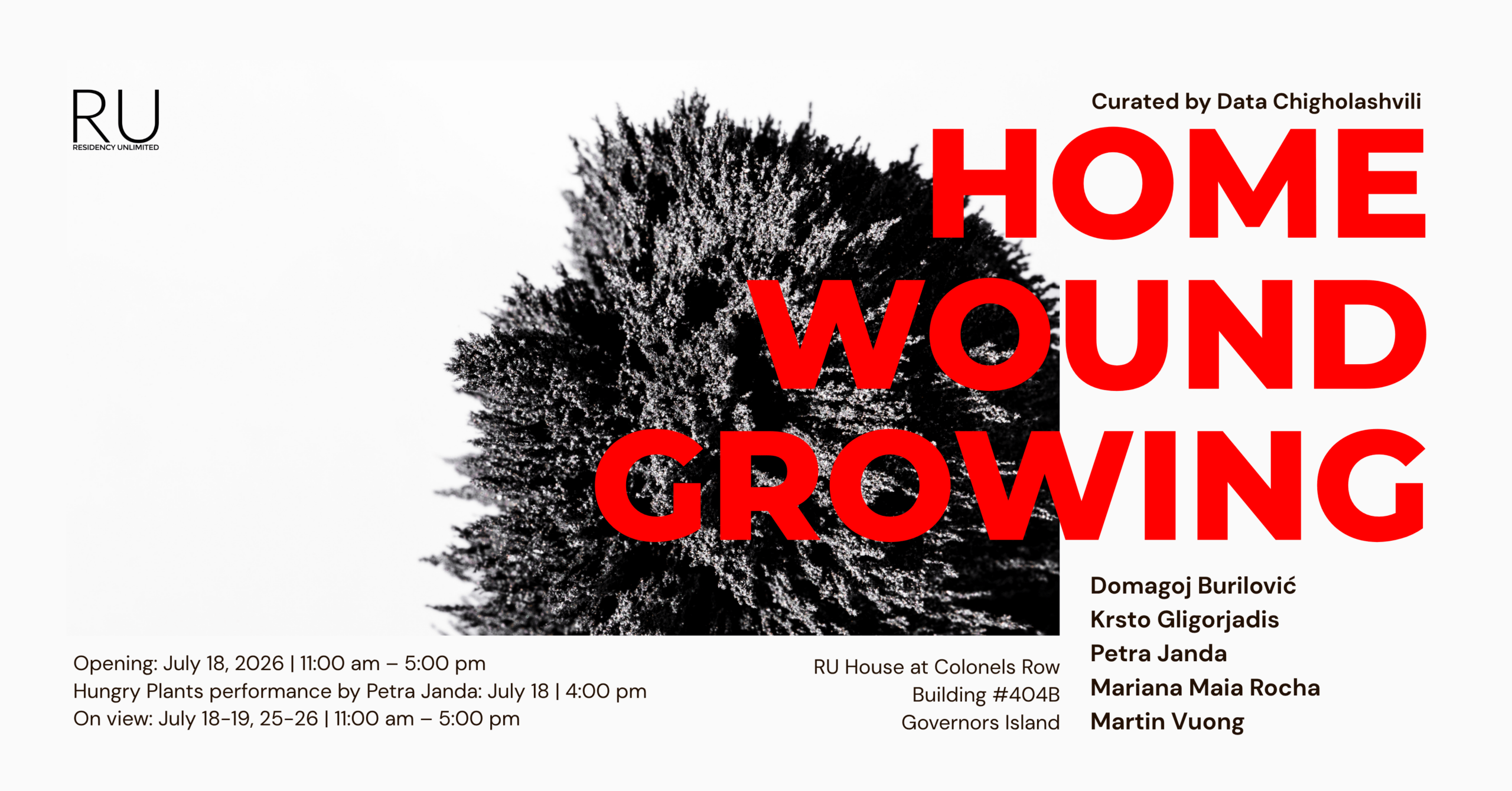
Opening: July 18, 2026 | 11:00 am – 5:00 pm
Performance “Hungry Plants” by Petra Janda: July 18, 2026 | 4:00 pm
On view: July 18-19, 25-26, 2026 | 11:00 am – 5:00 pm
Weekday visits by appointment
Location: RU House at Colonels Row, Building #404B on Governors Island (map)
Ferry information | Video directions
Please join us at the RU House on Governors Island to explore the works of RU resident artists: Domagoj Burilović, Krsto Gligorjadis, Petra Janda, Mariana Maia Rocha, and Martin Vuong. “Home, Wound, Growing” is curated by Data Chigholashvili, Curator of Residency Unlimited.
Set in a former residential house, the “Home, Wound, Growing” exhibition continues reflections on the notions of house and home – a leading conceptual line of 2026 exhibitions at the RU House on Governors Island. This edition weaves threads between landscapes of personal and collective memories, as well as the relationship between bodies and abodes – their vulnerability, resistance, and possibilities of growing. Featured works reflect on care and subtleties surrounding humans, plants, and architecture. Together, they explore how different bodies can be complex vessels seeking to find or grow into sanctuaries, yet, at the same time, be fragile and susceptible to time and external forces. The exhibition exposes cracks and wounds – physical or hidden in plain sight – explores the layers and agency involved in addressing them, and invites visitors to ponder what could grow out of them.
The works by Mariana Maia Rocha – “Tempus edax rerum”, “Memento Mori”, and “Wounded Cartography” – ponder on encounters between a human body and architecture. The artist explores ruins and cracks of built environments beyond mere signs of deterioration, and instead looks at them as parts of life that retain memory. In doing so, she confronts or adapts to these structural wounds with her own body – seen in part, or in fetal position – moving between corporeality, memory, and disappearance, suggesting how bodies and homes can relate to fragility, resistance, and renewal. Destruction and growth emerge as eerie metaphors in Martin Vuong’s painting “Chaleur (Warmth).” Aesthetically referencing École des Beaux-Arts de l’Indochine (Indochina School of Fine Arts), which influenced the hybrid modernism of 20th-century Vietnamese art, the artist critically examines the French colonial administration of Vietnam, and the related opium monopoly. The figure in the painting seems rather content, immersed in the field of poppies, the source of opium, a drug described as causing the sensation of warmth – evoked in the painting through symbols of burning flowers and clouds of smoke. Plants and their feeding habits are central in Petra Janda’s “Hungry Plants”, an ongoing project presented in two iterations during her residency at RU. Through researching how various plants develop their feeding habits and grow, the artist examines caretaking and its related worries, and in a broader context, interrogates the human appetite for resources and control. This edition presents an installation and a performance reflecting on domestic plants. The hungry plant-human body temporarily inhabits the exhibition’s living room, faces its inner shadows and cravings, seeking to overcome them and find shelter and harmony.
The relation of architecture and time is central in the work of Domagoj Burilović. In “Neudorf” (German for New Village), he reflects on the 19th-century houses built in Slavonia, the artist’s home region in Croatia, during a period when the region was settled by different groups from Central and Eastern Europe. However, the diversity of population, and architecture that reflected it, started to disappear due to the 20th-century wars, and later – migration and depopulation. The photographs of Burilović are visual memories of these houses floating above the grounds where they once stood, evoking silent if not invisible layers that places contain. The agency of making home and becoming also emerges in Krsto Gligorjadis’s work, where he critically examines the topic of masculinity. The installation of “The Pants” presents two videos – an earlier film and a new one shot on Governors Island – depicting the artist walking in long red pants, also installed in the house. Referencing the now obsolete rite of passage of breeching, marking young boys’ transition into their first pair of pants, the piece investigates the role of a man in today’s society. The original performance consists of three acts: walking with the pants, recognizing social expectations; washing them as a symbol of responsibility; and hanging them, challenging traditional roles, and addressing wounds and growing.

Click above to see pictures from the exhibition.
About
Domagoj Burilović – a finalist of the 2025 Radoslav Putar Award – is a Croatian photographer. In his practice, he explores the political and social issues of Slavonia (region of Croatia) through local history, culture and migrations. He works with digital photography and its manipulation to create liminal spaces, build atmosphere, and describe the psychological and social landscape of the community in which he lives.
Krsto Gligorjadis – the recipient of the 2025 DENES Award for Young Visual Artists in North Macedonia – is a multidisciplinary visual artist and performer whose work fuses ritual, myth, and contemporary questions of masculinity, shaped by the chauvinistic context in which he lives and works. Trained in law, pedagogy, graphic design, and visual arts, his interdisciplinary practice bridges gender rights, societal critique, and personal transformation. Through performance, installation, and participatory works, Gligorjadis explores how private emotions become public reflection, questioning what it means to be a man today. His body-centered practice functions as a therapeutic ritual, transforming trauma into embodied artwork and creating spaces of empathy, accountability, and healing.
Petra Janda – the laureate of the 2023 Jindřich Chalupecký Award – is a multimedia artist moving across the spheres of creation and education, always interested in the relations between people and environmental issues, sustainable development of the outer world, and the ways to improve the environment, both external and internal – psychological. She is aware of the interconnectedness of the inner processes and of the influences they bear on the surrounding world. Her site-specific installations or art objects deal with the preservation of natural processes and life. In her work, she expresses ecological concerns not only via protective and predominantly feminine motives, but she also understands them as means of interpersonal communication. Her artistic creation responds to the current life with openness, indeterminacy, subtlety, and mystery, and relates to it by including community projects, ancient myths, and inner spirituality.
Mariana Maia Rocha is a visual artist and researcher whose interdisciplinary practice operates at the intersection of body, memory, and urban space. Working across drawing, photo-performance, installation, and material-based processes, she approaches drawing as an expanded field in which the body becomes an instrument of inscription. Through gestures of friction, pressure, and transfer — using graphite, latex, wax, and direct contact with architectural surfaces—her work produces indexical traces that register time, labor, and spatial transformation. Engaging with archives, ruins, construction sites, and provisional architectures, Rocha investigates how contemporary cities operate through cycles of construction, disappearance, and replacement. Her work reveals fragile material residues embedded in urban surfaces, positioning the body as a critical device capable of exposing the tensions between visibility and erasure that structure contemporary spatial experience.
Martin Vuong is an emerging artist specializing in figurative oil painting, with a focus on portraiture. His work explores heritage, memory, and cultural identity through a diasporic lens, drawing on his Vietnamese background and colonial history. He examines the intersection of personal and collective narratives, translating overlooked stories into visual form. His paintings combine realistic figures with symbolic and surreal elements. He works from archival photographs, historical advertisements, found images, and linguistic expressions, reinterpreting them to reflect on how histories are constructed and remembered. His recent work focuses on French colonialism in Vietnam and its lasting social and cultural impacts.
This exhibition program is supported by the Trust for Mutual Understanding, and Shuttle Programme – Pláka Platform, Porto City Council.
This program is supported, in part, by public funds from the New York City Department of Cultural Affairs in partnership with the City Council. In-kind support is provided by Materials for the Arts.

RU is grateful for the partnership with Governors Island Arts.