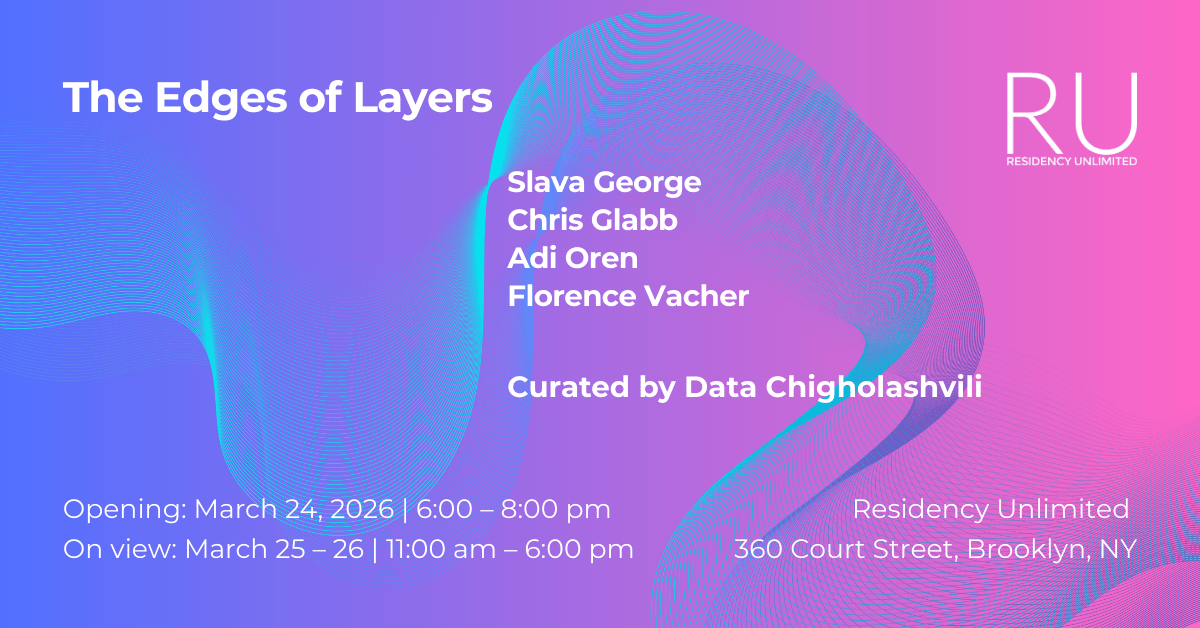
Opening reception: Tuesday, March 24, 2026 | 6:00 – 8:00 pm
On view: Wednesday, March 25 – Thursday, March 26 | 11:00 am – 6:00 pm
Location: Residency Unlimited, 360 Court Street (main green church doors), Brooklyn, NY 11231 (map)
Please join us for our first group exhibition of the year featuring works by RU artists: Slava George, Chris Glabb, Adi Oren, and Florence Vacher. “The Edges of Layers” is curated by Data Chigholashvili, Curator of Residency Unlimited.
Exploring layers of both materials and ideas, create the main line of thought in this group exhibition. Using paints, textiles, prints, or digital images is essential in the artists’ works as much as combining various symbols, memories, and narratives into them. It takes delicate work to make an assemblage, when each material, before the other, conditions the result, and in doing so, also interplays with respective concepts and stories. At the same time, as they amass, subtleties, edges, and fine lines emerge, allowing a careful viewer to discover the process of layering. The works in the exhibition explore this through color, shape, and material, while reflecting on personal narratives and collective remembrances. Therefore, they suggest unraveling the complexities of memory and [dis]embodiment, including moments when symbols blur in the overwhelming flow of information or the fast rhythm of life. Considering the above said, this exhibition invites spectators to take a moment, have a close look, and explore the edges of – material and symbolic – layers they encounter.
Adi Oren explores the limits of figurative painting, where the starting point is often everyday encounters, personal memories, or archival material. Figures in her paintings are often suspended in movement with anticipation of continuation; however, instead of appearing in realistic settings, they float in the layers of colors around them. Layering is an essential component – colors of paint on canvases create textured environments, fragments of memories are reimagined through them, and sometimes, inspired by the exquisite corpse, different canvases assemble into one composition. In “The Edges of Layers,” several paintings by Adi Oren are assembled on top of each other, creating an inquiry into transitioning and blurring between the edges. Additionally, this serves as the core of her installation in this exhibition, as it relates to her other smaller works that float throughout the space, like daydreaming, or moments of returning to particular memories or feelings.
Through the layers of printmaking, Chris Glabb explores how a symbol can simultaneously be appealing while carrying a heavy connotation for some. In the “Spotted with Pansies” series, he looks at pansies as aesthetically pleasing floral representations, while also being a slur in the English language against gay men, and in doing so, the artist deals with traumatic experiences of derogatory language. Reflecting on personal experiences and fear of being seen before coming out, Chris Glabb is interested in ambiguity as a form of survival. He intentionally makes these works look pleasant on the surface, referencing contexts where queerness is “accepted” as long as it’s not talked about. The dots that appear throughout his installation evoke Pop Art and also reference digital aesthetics – the layers of which translate into a combination of silkscreen and painting on wooden panels. Whilst they first come across almost like digital prints, a closer look reveals how they are constructed through printing, hand-painting, and layering, which also allows intentional slippages.
In her practice, Florence Vacher addresses the various aspects encompassed by artifacts from bygone eras. Following her studies and work on ancient African art, leading to developing sensitivities and awareness surrounding these objects, she started making art by translating their materiality and stories into multi-layered, predominantly textile works. Considering critical discussions around ownership and repatriation of non-Western items held in Western collections, she explores how contemporary art can engage in these processes. Florence Vacher focuses mostly on historical wooden objects and, to unravel the complexities of stories and displacement concerning them, she intentionally chooses textiles and embroidery in her artworks. This references the change in the original functions of these artifacts, as well as moves to softer materials, also opening up discussion on the topic of gender. Therefore, these new representations of objects that have lost their once-ritual or daily functions in remote geographies, along with changes in scale, material, and color, explore their authorship, agency, and contemporary narratives.
“You are so hot, you are bringing me down” by Slava George is a metaphorical commentary on symbols losing their power and meanings getting distorted. Conceptually, the artist reflects on the current global state of an overwhelming amount of bad news everyone’s talking about, wherein the layers become hard to trace. In “The Edges of Layers” exhibition, she presents a video piece with a rather slow rhythm as a reaction to today’s fast-paced lifestyle and compulsive doomscrolling, where one image quickly replaces another, leaving one stunned or impassive for a while. Candles, often seen as symbols of hope and prayers, here become eerie metaphors of attacks on fundamental human rights. Slava George intentionally takes a tragicomical approach and additionally creates a shrine-like installation – meanings and signs turn upside down, referencing the divisive populist narratives and the perception of meanings on the surface only, which is becoming harder to grasp through the superfast change of news and scrolling images.

Click above to see the images from the program
About:
Slava George is the recipient of the 2025 BAZA Award for young contemporary artists in Bulgaria. Slava George is a multidisciplinary artist based in Sofia. She works with various media – installation art, sculpture, performance, video, photography and conceptual fashion design. Her artistic position is deeply connected to the role of women and the feminine as a social construct. She deconstructs elements of reality to the point where the processes of social belief formation become the object of critical analysis. In her artistic research, she seeks the connections between social phenomena such as alchemy, myths and rituals, and specifically, how they are intertwined within the collective subconscious and the human condition. The link between millennia-long traditions and contemporary times is at the core of Slava’s work, analysed through psychology, anthropology, ethnography and more. Many of her projects are related to topics like human rights, war conflicts and current political issues.
Chris Glabb aims to make the themes of Fine Art accessible through lowbrow referentiality, irony, a dry sense of humour, and the explicit appropriation of existing images. His practice is grounded in the philosophy that images and references function as social currency – tools that provide access to spaces, experiences, and opportunities that would otherwise be inaccessible. Engaging with questions of hierarchy, intersectional Queerness, and Indigenous identities, Glabb employs a Post-Pop Art sensibility to redefine relationships between moments in culture through processes of image manipulation and printmaking. Video games, fashion, and non-objective painting provide recurring points of reference in his practice, shaping his ongoing examination of how popular imagery functions as a site of connection, critique, and cultural negotiation.
Adi Oren is a figurative painter drawn to moments where edges blur, light shifts across the body, and memory flickers into the present, revealing an interior world. Her work begins with archival photographs, family images, and everyday encounters that she fragments and reimagines, allowing figures to drift and unfold within layered fields of color and texture. Working in acrylic, ink, and repurposed materials, she builds each surface through drawing, glazing, dry brush, and impasto. She approaches the canvas as an evolving site of choices and chance, using shifting color harmonies to create the illusion of light and possibility.
Florence Vacher is a Brooklyn-based self-taught artist specializing in large-scale figurative textile work. She began her current series following a transformative trip to Mexico in 2011. This expedition ignited within her a profound desire to breathe new life into objects from bygone eras by changing their scale and representing them in fabric and thread. Using carefully selected fabrics, which she layers and arranges like paint on a canvas, she is able to explore new dimensions of texture, color, and form. Vacher, who comes from France, developed an expertise in the arts from Africa, working alongside collectors in Paris and later in New York, where she has lived since 1998. She has spent decades admiring and studying these objects and observing the ways in which artists, dealers, curators, and collectors have been approaching them since they were first “discovered” in the early 20th century.
This program is supported by the Trust for Mutual Understanding and the Canada Council for the Arts.


This program is supported, in part, by public funds from the New York City Department of Cultural Affairs in partnership with the City Council.