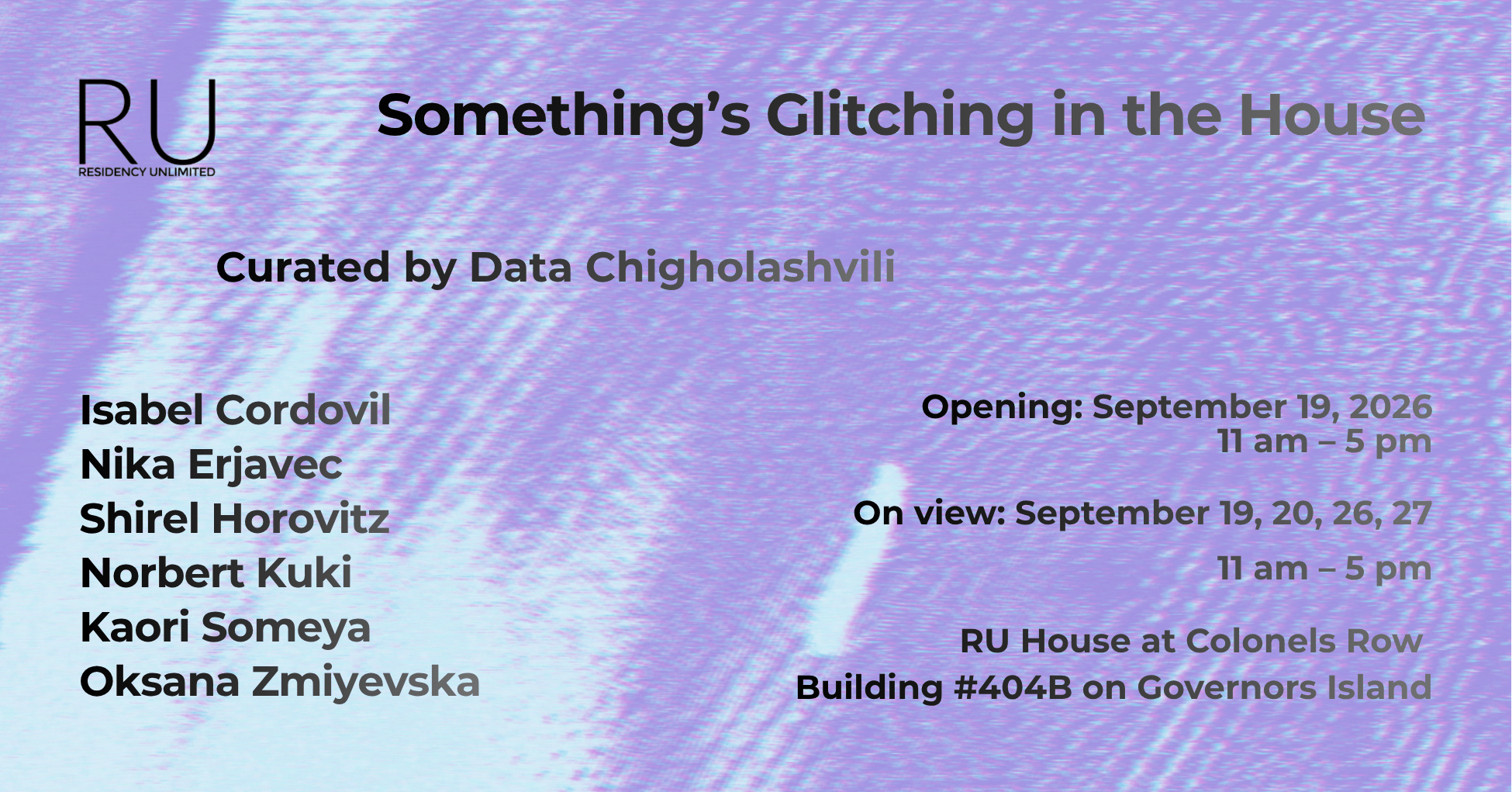
Opening: September 19, 2026 | 11:00 am – 5:00 pm
On view: September 19-20, 26-27, 2026 | 11:00 am – 5:00 pm
Weekday visits by appointment
Location: RU House at Colonels Row, Building #404B on Governors Island (map)
Ferry information | Video directions
Please join us at the RU House on Governors Island to explore the works of RU resident artists: Isabel Cordovil, Nika Erjavec, Shirel Horovitz, Norbert Kuki, Kaori Someya, and Oksana Zmiyevska. “Something’s Glitching in the House” is curated by Data Chigholashvili, Curator of Residency Unlimited.
The group exhibition “Something’s Glitching in the House” thematically moves between bodies, homes, and domestication – conceptual threads woven throughout the 2026 exhibitions at the RU House. Through this iteration, the artistic interventions and presentations brought together in the former residential house on the island, inquire into glitching, movement, liminal spaces and what could exist in-between. Glitching here is a metaphor for the unexpected surfacing within an established routine or system – revealing its imperfections and hinting at alternatives. The exhibition looks at the structures that define how different materials, forms, socio-cultural markers, and ideas come together. Furthermore, in the age of accelerated information and algorithms, amid growing solitude and confusion, the works explore how an interruption, a pause, an imagination, or that which does not fit the frame can redefine those very systems. The exhibition brings together works of various media – painting, drawing, video, sculpture, and installation – many of which challenge belonging to one form only through their execution and representation. Together they invite the visitors to ponder binaries, classification, frameworks, motions, different bodies and abodes, and explore what it means to be a part of a larger system – how to relate to different elements, yet resist unification, pay attention to subtleties, and notice what might not be directly there.
Exploring abandoned spaces, urban wilderness and posthumanist landscapes, Nika Erjavec’s sculptural installations test our perception through the senses. The artist brings together plants and found objects, and creates subtle yet accelerated motions between marginal points. In doing so, what we expect to see in her kinetic-audio sculptures becomes purposefully hard to perceive as stable images. The installation in the dimmed room is built using discarded human-made objects and dry plants gathered around NYC during her residency. Through light, sound, and vibration, Erjavec produces subtle rapid motions and frictions as metaphors for unsanctioned movement and ecosystems taking over. Following Legacy Russell’s “Glitch Feminism: A Manifesto” (2020) – viewing glitch as a radical tool for liberation – the glitches here come from overstimulated movement as symbols of rapidly changing environments, and become artistic tools to expose systemic disruptions and relations between different interconnected parts.
Isabel Cordovil’s work exposes underlying structures concerning visual culture and communication of knowledge. Echoing Aby Warburg’s Bilderatlas Mnemosyne (Mnemosyne Atlas) – as a form of knowledge collection, connection, and influence – the artist presents an installation with standard file folders referencing the physical limitations of holding visual and textual materials. Exposed colors and surfaces of the folders, rather than the materials they hold, create a clean geometric abstract mosaic, hinting at patterns underlying material gathering. In doing so, it comments on the fragmentary character of archives, the historical and psychological aspects of knowledge, and how pictorial and written sources organize and relate to each other. This evolving installation relates to the recurring topic in the artist’s practice concerning symbolic meanings as opposed to how things function in reality.
Expressing meaning more symbolically than directly is central to Kaori Someya’s practice. The paintings “ACE” and “JACK” reference an individual need to be alone and yet yearning for connections with others, especially as a result of isolation that accompanied the recent COVID Pandemic. In her work, the artist often utilizes traditional Japanese techniques such as urahaku – applying metal leaf behind a very thin paper. This creates an emanating light effect from beneath the painting, often appearing in her depiction of kimonos worn by women. This places Someya’s practice in a space between traditional and contemporary approaches, through which the artist revisits various cultural markers. In doing so, she also references the Japanese term “awai” – a blurry in-between area where boundaries are not distinct – positioning her work in the contemporary context, and looking at what’s between the viewer and the work not as an empty space, but an area of soft connection.
Bringing together various elements and shapes runs through Shirel Horovitz’s two- and three-dimensional pieces. Works from the ongoing “Possible Furniture & Credible Dreams” series oscillate between drawings and paintings, as well as between imagination and reality. The figures – or rather hybrid human-architecture-furniture creatures – seem to have defied gravity or the strictly defined functionality of built environments. Not meant to be representations of physical works, they instead read like dreams where bodies and structures intuitively merge. A somewhat similar approach, yet more physically present, is found in Horovitz’s sculptures evoking familiar shapes that cannot be placed in a conventional category. Domestic and found objects, wooden pieces, upholstery, or skin-like surfaces of pigmented glue come together in new forms. At the same time, material boundaries and traces of creation are made visible as metaphors for gathering and nonlinear paths of transformation.
Togetherness, bodies, and movement are some of the main themes explored by Oksana Zmiyevska. Whether it’s portraits of herself, others, or compositions with several figures, her paintings depict a certain liminality concerning intimacy and distance. Additionally, as evidenced in her current “Dancers” series, the artist often references important moments in art history – the canonical early 20th-century work “Dance” (“La Danse”) by Henri Matisse, where nude dancing figures cannot be placed in a specific context, and become symbols of energy and joy; and the 2014 series that David Hockney created in homage, where the loop seems more closed and references the 21st century, also directly visible in the athletic wear of dancers. With the diptych “Dancers” on view, Zmiyevska aims to continue this lineage with a somewhat in-between state, where paint and color move between clothing, setting, outlines, and figures, which are together yet somehow apart.
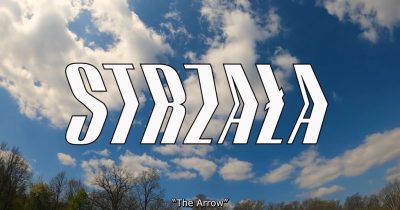
Norbert Kuki explores the layers of contemporary Roma culture and identity, and how to preserve and retell related stories. In “Filozofia Vagabundstva / Philosophy of Vagrancy”, he focuses on the diversity and complexity of the endangered Romani language, examining it as always changing and having multiple forms. Looking at the trope of “wandering” – often wrongly attributed to Romani people as a lifestyle choice, rather than a forced displacement and a vital survival response to the centuries of persecution and oppression – the film starts with Roma legends about them being condemned to wandering. Following this, the artist’s analysis of the Romani language and music exposes the limitations of established systems and boxes. Pitching and algorithmic tools of streaming services – needed for music popularization – have their own underlying structures requiring unification and flattening diversity; yet Kuki calls for resisting consolidation of the many Romani dialects, and says: “But the world works the other way around and without a unifying language, we can only wander.”
Click below to see pictures of the event:

About:
The work of Isabel Cordovil mainly investigates the politics of revisiting narratives – be it in myth, folklore, religion, literature, dreams, or around the collective unconscious – and new possible navigations or manipulations of them. Accepting language and symbols as the process of meaning-construction, her research and creative process is always towards broadening their spectrums of agency. Despite its physical absence, the human body often operates as a principal subject, as a mediator between the self and the external world, a measuring device set out to explore themes tied to (gender) identity, the self, sites of political discourse, finitude, and death. Mainly through installation and sculpture, Isabel’s work reflects a poetic language of playful metaphor, a freedom and visual disobedience that search for new ways of belonging/defying and celebrating otherness.
Nika Erjavec – the winner of the 2025 OHO Award – is an interdisciplinary artist focused on the ways sensory languages and systems shape and challenge modes of sensing. Grounded in research and hands-on experimentation, she is currently exploring urban wilderness and working with the physicality of vibration and light, creating interactive installations that probe perception and our idea of reality. Her most recent solo exhibition (un)objectivity (2024) was presented at the Museum of Contemporary Art in Ljubljana. Nika Erjavec has two permanent installations: the interactive light ambient Cellular Landscapes (2024) in front of the University Medical Centre Ljubljana and the interactive sound installation with Doroteja Erhatič V/Posluh (2022) at the Slovenian Institute of Chemistry in Ljubljana. During her master’s studies, she received the highest award of the Academy for her series of installations and hybrid artistic research (2019). Nika Erjavec is a member of the teaching staff at the Academy of Fine Arts and Design, University of Ljubljana in the Video, Animation and New Media department. Since 2014, she has been actively exhibiting in the local and international context.
Shirel Horovitz’s practice is driven by the intersection of urban architecture, furniture, and the human figure. She gathers materials and inspiration from the streets to craft with them hybrid sculptures that are part dysfunctional furniture, part creature. The rationale of her work relies on the tension between the memory of the functional whole and new imaginary spaces and forms. Shirel works across different spaces and in collaboration with professionals from various disciplines, inviting their expertise to shape the logic of her work. This commitment to exchange and respect for diverse forms of knowledge also informs her relationship with audiences. Her work seeks to engage viewers on multiple levels: inviting in-depth conversations around artistic practice and art history while remaining communicative and evocative regardless of age, background, or academic knowledge.
Norbert Kuki – one of the 2026 laureates of the Oskar Čepan Award for contemporary art in Slovakia – is a Roma artist from Slovakia. With a background in visual art and music (hip-hop/rap), he uses art to define contemporary Roma identity and as a tool for preserving, disseminating, and explaining Roma culture. His work draws on the Romani language, stories, and legends, which he explores from multiple perspectives. Recently, he has focused on questions related to what it means when a language becomes official, how translation functions, the impact of globalization, and the role of music in sustaining language. He was a participant of a group exhibition Smoke & Mirrors at Pálffy Palace – Bratislava City Gallery, Slovakia (2025-2026). He is often a part of screening programs, and in 2025, he participated in screening and discussion of Kambium 1492 + Filozofia Vagabundstva (Philosophy of Vagabondism) at Žilina-Záriečie Station, Žilina, Slovakia.
Kaori Someya is a Japanese painter whose work explores contemporary female identity through traditional Japanese painting materials. Using mineral pigments, ink, and metal leaf on traditional Japanese paper, she creates decorative yet contemplative images of women that reflect the complexities of living in contemporary Japanese society. Her work is influenced by her mother, who made kimonos as a hobby, and her training in traditional mounting techniques, including byōbu (folding screens) and kakejiku (hanging scrolls), during graduate school. Pattern and ornamental structures derived from kimono design often appear in her compositions, suggesting shifting and fleeting landscapes. Through the use of metal leaf and the uniquely Japanese technique known as urahaku (reverse metal leaf), she explores reflective light, invisible margins, and the subtle spatial relationship between artwork and viewer, drawing on Japanese perspectives on light and perception.
Oksana Zmiyevska’s body of work explores portraiture as a political and psychological genre. When it comes to self-portraits, Zmiyevska candidly exposes vulnerability and self-criticism, but also admiration and experience of self-intimacy. Partly painted from her private archive, sometimes referencing to the great masters, or just sketched in front of a mirror, she delves into the complexity of boredom and excitement of having this one particular body, this one particular face—the one you know the most, yet the one that still surprises you. In multi figure compositions, Zmiyevska develops imagery of intensity of being together. Whether it is a sensual moment between two, or a basketball match, or castellers, or gamblers in a casino, the artist always focuses on the event of nearness to the others and the ambiguity of it. (Text by Liudmila Kirsanova)
This exhibition program is supported by the Trust for Mutual Understanding, FLAD, Artis, CSP and Nomura Foundation.





This program is supported, in part, by public funds from the New York City Department of Cultural Affairs in partnership with the City Council. In-kind support is provided by Materials for the Arts and McCoy’s Upholstery..


RU is grateful for the partnership with Governors Island Arts.