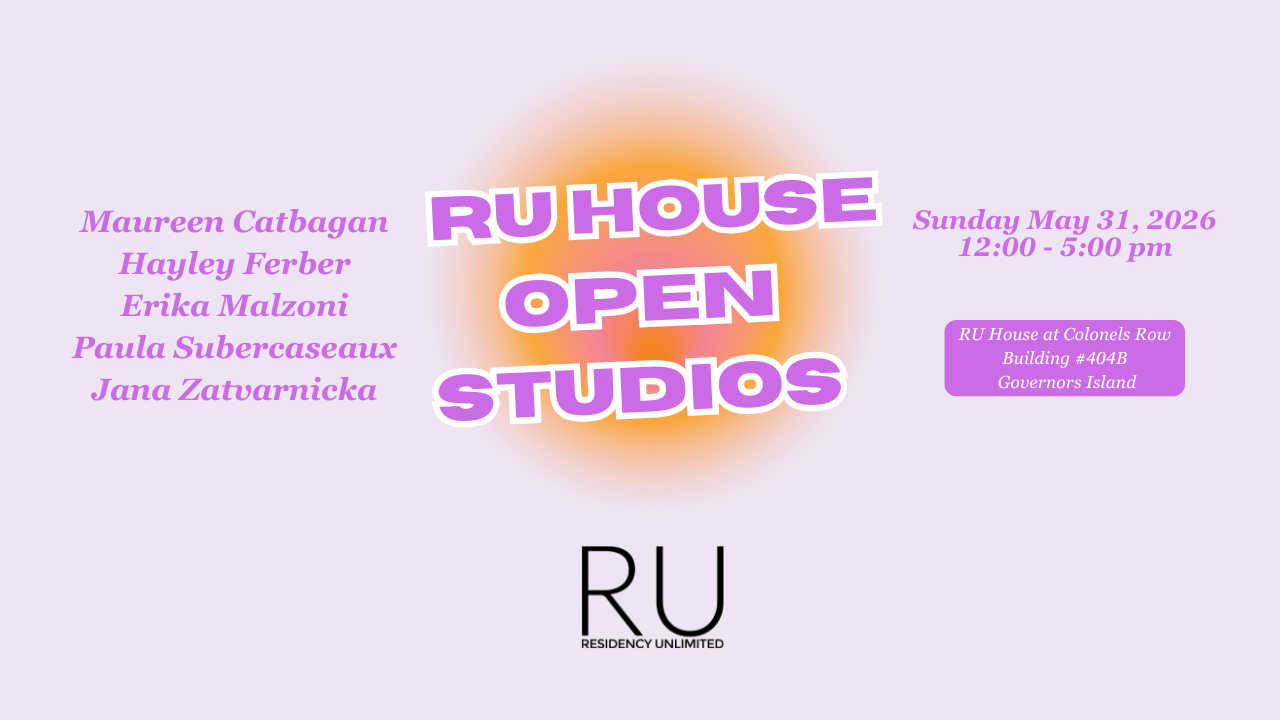
Sunday May 31, 2026
12:00 – 5:00pm (House opens at 11:00 AM)
Location: RU House at Colonels Row, Building #404B on Governors Island (map)
Ferry information | Video directions
We are thrilled to have continued presence on Governors Island as part of the 2026 Organizations in Residence program. On May 31, starting at noon, we warmly invite you to visit the RU House for our first open studio event with local RU alumni and international artists Maureen Catbagan, Hayley Ferber, Erika Malzoni, Paula Subercaseaux and Jana Zatvarnicka. Visitors will have the opportunity to engage with their creative processes and discover works in progress firsthand.
To get here, ferry rides are free on weekends before 11am — so please join us and take this opportunity to make a day of exploring the Island!

Click above to see the images from the program
About
Maureen Catbagan (2023 RU/NYCBAR alum) is a Filipinx-American multimedia artist based in New York, whose work engages social collectivity and explores the intersections of immigration, labor, and visibility. Collaborations include Flux Factory, Yams Collective, and Abang-guard with artist Jevijoe Vitug. Recent exhibitions include Theseus’s Craft: The Paradox of the Real at Lichtundfire Gallery, NYC (2026); Abang-guard: Makibaka at Queens Museum, Queens, NY (2025-2026); and Alagaan ang Salaysáy (Take Care of the Story), a solo exhibition at Flux IV, Long Island City, NY (2025).
Hayley Ferber (2023/2024 RU alum) is a multidisciplinary artist whose work explores nautical themes through artist books, prints and paintings. Born on Long Island and now based in Brooklyn, Hayley delves into the layered, symbolic world of maritime culture, where sea life, ships, and cartography serve as metaphors for struggle, resilience, and transformation. She received her MAT in Art & Design Education from RISD and a BS in Studio Art from NYU. Hayley has exhibited solo at Yashar Gallery and in group shows at Kalamazoo Book Art Center, AIR Gallery, 440 Gallery, Established Gallery, and BWAC among others.
Erika Malzoni (2026 RU artist) is a Brazilian visual artist working across sculpture, installation, and text-based interventions. Her practice mobilizes everyday materials – ceramics, textiles, mirrors, packaging, and found objects – to interrogate structures of visibility, value, and belonging. Treating language as both medium and material, she activates public and intimate spaces through subtle gestures of repetition, displacement, and accumulation. Her work often reveals the invisible networks that connect people, objects, and everyday life. Before dedicating herself fully to visual arts, she studied data processing and later completed a Postgraduate Certificate (Lato Sensu) in Systems Analysis at FAAP – Fundação Armando Alvares Penteado in São Paulo (1988), an early formation that resonates with her ongoing interest in relational structures, networks, and patterns of connection in everyday life. She has maintained an independent visual arts practice since 2009.
The Chilean artist Paula Subercaseaux (2026 RU artist) explores the interrelations between movement, materiality, and the perceptual experience of nature. Working primarily with ceramics and watercolor, her work investigates how form arises through processes of motion and embodied gesture, and how states of stillness can preserve the trace or memory of movement. Her early training in watercolor was formative, establishing a foundational link between material exploration and sensory experiences rooted in childhood. Nature, and its profound connection to the human psyche, constitutes a central axis of her research. Through her work, Subercaseaux seeks to make perceptible the subtle and often hidden dynamics that operate within natural systems.
Jana Zatvarnicka (2025/2026 RU artist) explores the entanglement of human and non-human forms through ecofeminism, ritual, and material transformation. Through painting, installation, and organic materials such as rust, wax, gold, hair, and pigments, she creates hybrid bodies that dissolve boundaries between plant, soil, body, and environment. Her work approaches painting as a process of imprinting— leaving traces of touch, gesture, and time that function as both physical residue and symbolic language.
This program is supported, in part, by public funds from the New York City Department of Cultural Affairs in partnership with the City Council. In-kind support is provided by Materials for the Arts.

RU is grateful for the partnership with Governors Island Arts.