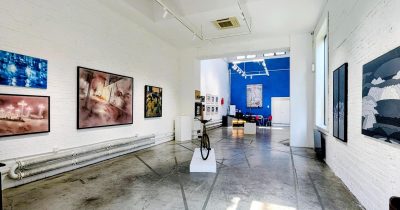
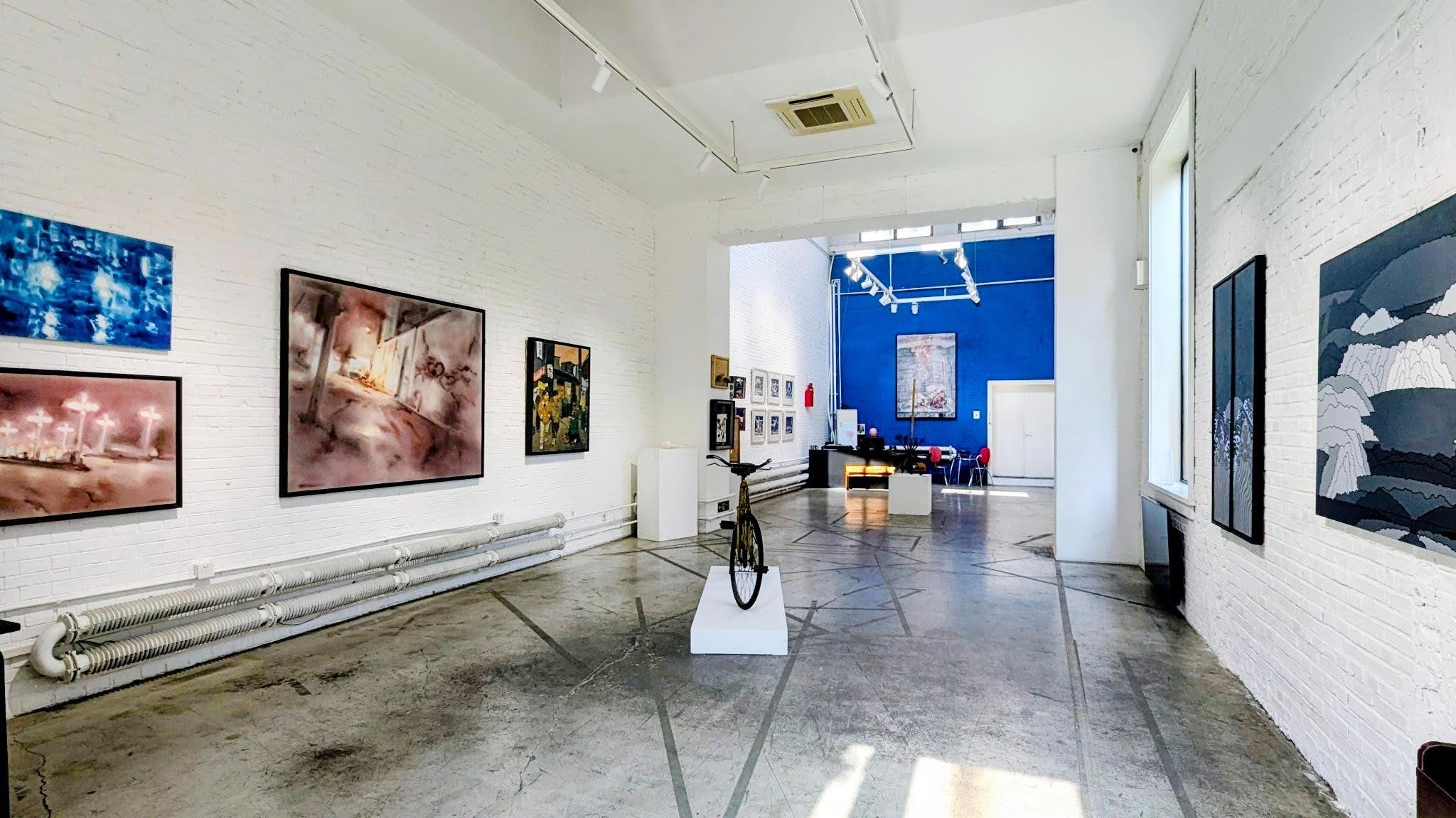
Installation view of Origins of Artist Residencies in China, Red Gate Gallery, Beijing, October 2026.
By Hu Chao
Readers with personal experiences, archival materials or information about the history of artist residencies in China and elsewhere are warmly invited to contact the author at huchao.beijing@gmail.com.
One of the most high-profile international contemporary artists to spend an extended period living and working in China was probably Robert Rauschenberg. During a five-week visit in 1982, he travelled through the country and worked with traditional Chinese paper in Jingxian, Anhui, creating his 7 Characters series. His encounters in China also informed his wider practice, and in 1985 he presented exhibitions in Beijing and Lhasa as part of the Rauschenberg Overseas Culture Interchange (ROCI).
Although these visits were not part of a formal artist residency programme, they offer an early example of the possibilities opened by spending time and making work in China. From the early 1990s, organised residency programmes began to give such exchanges a more sustained structure. How did these programmes take root, and how did they develop through international partnerships, local organisations and artists’ own initiatives?
Much of the history of contemporary Chinese art has been written through artistic movements, major exhibitions, biennials, the market and artists’ growing international visibility. The residency programmes that enabled artists to live and work elsewhere have received less sustained attention as a subject in their own right. Often mentioned briefly in artists’ biographies, these experiences have rarely been brought together into a connected historical account. My research brings these scattered histories into focus, asking how residencies helped shape artistic practice and the networks through which contemporary Chinese art developed. While preparing the exhibition Origins of Artist Residencies in China: Another Pathway to Contemporary Chinese Art, I kept returning to a question behind the more visible events: how did artists actually come to know the world?
Artists could stay for weeks, months or longer, entering another rhythm of daily life, social relations and artistic work. They gained embodied knowledge: an understanding acquired through living and working that exhibitions, publications and images alone could not provide. These experiences travelled further through conversations among artists, exhibitions, discussions and teaching, helping others understand and participate in the globalising art world.
For this reason, I see residency as one of the practical mechanisms through which contemporary Chinese art took shape. My research began by tracing and comparing hundreds of residency programmes in China and abroad, alongside international exchange projects, institutional archives and artists’ own experiences. Bringing these dispersed materials together made it possible to follow connections that are easily missed when residency appears only as a line in an artist’s CV.
The exhibition’s Chinese title translates literally as Borrowing the Shell. The phrase can refer to a backdoor listing in finance, where an existing structure provides access to resources and connections. It also evokes inhabitation, adaptation and growth. For an artist, the borrowed shell might be an institution, a city or a network of relationships. Living and working within it can change how the artist understands both that environment and themselves.
| “In China I was a bag lady on a bicycle, scouring the street, listening and watching. A language encoded with no tools to decode, my place caught between the physical and the temporal. Making meaning of this became a negotiation between fact: conventional observations, and fiction: constructions, allusions.”— Jayne Dyer, Artlink, December 1998. |
From this research, I developed three related perspectives: Transplantation, Grafting and Mycelium. They trace the arrival of a residency model, its adaptation to local conditions and the growth of more dispersed networks. They are a working framework drawn from the material, rather than fixed categories into which every programme must fit.
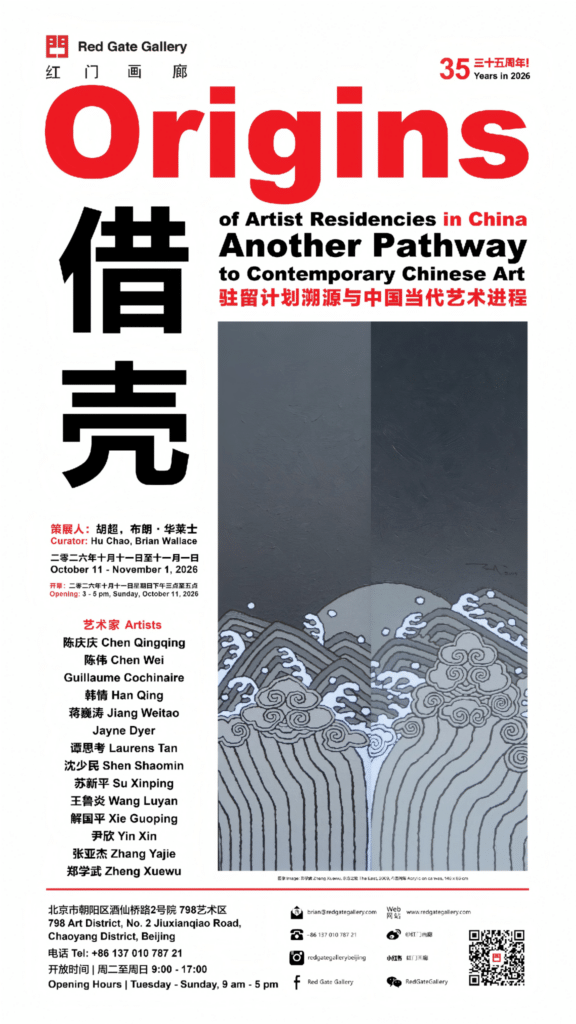
Official exhibition poster for Origins of Artist Residencies in China: Another Pathway to Contemporary Chinese Art (Borrowing the Shell), Red Gate Gallery, Beijing, 11 October–1 November 2026. Courtesy of Red Gate Gallery.
Transplantation
The first perspective concerns the arrival of organised residency programmes in the 1990s and early 2000s. In the early 1990s, Australia’s Asialink began sending artists to China on residencies. Red Gate Gallery, founded in Beijing in 1991 by Brian Wallace, helped artists find accommodation and studio space and connect with the local art community. A few years after beginning to send artists to China, Asialink also selected Chinese artists to go to Australia, gradually developing a two-way exchange.
These continuing relationships gave cross-border artistic exchange a more stable organisational basis. A residency offered time to make work and develop relationships within a place, extending the possibilities of a short visit or exhibition. This helped the model take root in China’s emerging contemporary art environment.
This research culminated in the exhibition Origins of Artist Residencies in China: Another Pathway to Contemporary Chinese Art at Red Gate Gallery in Beijing (11 October–1 November 2026). The exhibition’s Chinese title, 借壳, translates literally as ‘Borrowing the Shell’, which is also used as a shorter name for the exhibition.
Grafting
The second perspective asks what happened as the model became established locally. In 2001, Red Gate Gallery launched its own residency programme in Beijing, building on its cooperation with Australian partners. The same year, the Chinese European Art Center, or CEAC, began its residency programme in Xiamen, in southeast China.
CEAC maintained close connections with Europe while working through the cultures, workshops, universities and social resources around it. Red Gate and CEAC show how an international model could take different forms through its relationship with particular places. The opportunities available to artists depended on the people, resources and artistic communities they encountered there. Through this process of grafting, residency became part of local artistic life while continuing to connect it with other parts of the world.
Mycelium
Mycelium describes the more dispersed developments that became visible from around 2009. Museums, academies, independent spaces, commercial organisations and artists themselves established programmes that appeared, changed, ended and sometimes continued in new forms. This wider landscape also included artist-led initiatives responding to Chinese artists’ needs, such as Shangyuan Art Museum and Zheng Xuewu’s Hudson Art Center in the United States.
Platforms helped connect programmes that had previously been scattered. Founded in 2013, China Residencies connected residency programmes, institutions and artists across China and the world through its website and a series of reviews and reports covering 2014–2021. The image of mycelium offers a way to understand these relationships: growth across different sites, with connections extending between organisations, artists and regions.
The three perspectives also suggest different directions in China’s artistic engagement with the world: the early importance of Australia, CEAC’s connections with Europe, and later exchanges with the United States and wider global networks. These are the principal geographical lenses of the exhibition, rather than a complete map. The relationships were broader, more reciprocal and more polycentric than a single account of Western influence on China would suggest. Exchanges within Asia, and between China and other regions, remain to be traced in greater depth.
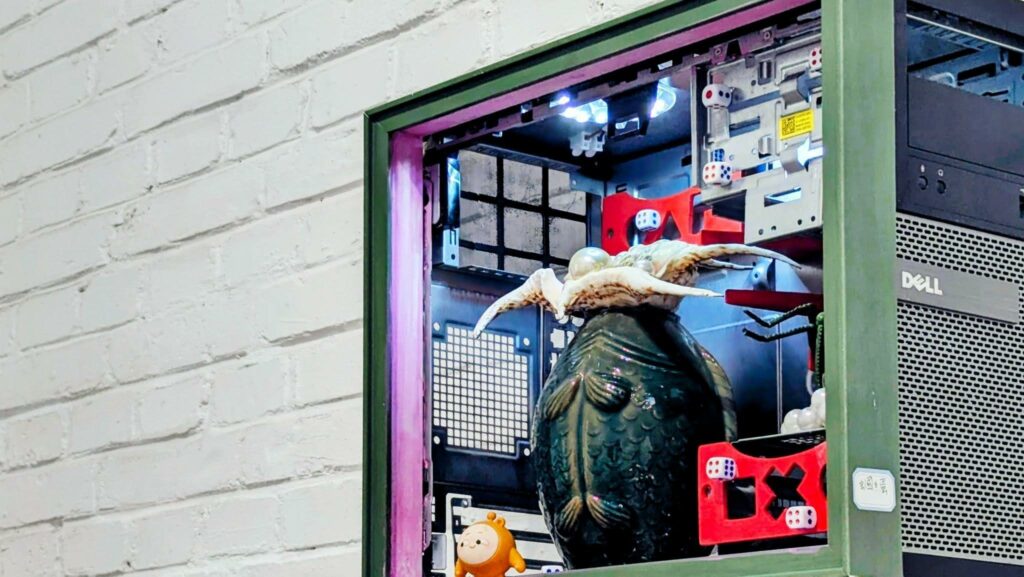
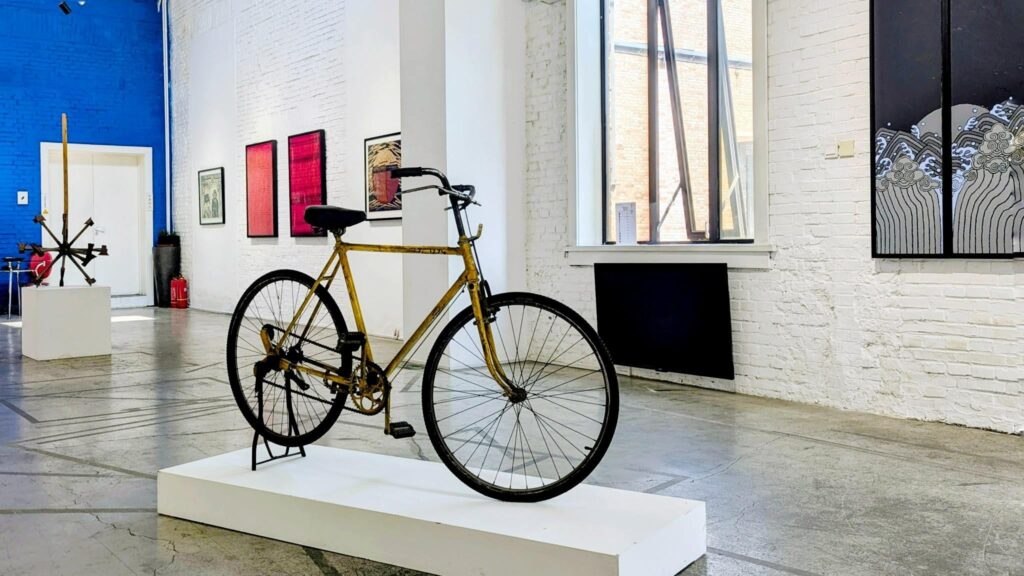
Installation view of Borrowing the Shell, Red Gate Gallery, Beijing, 2026. Detail of Chen Qingqing’s Egg, 2025. Photo: Zhang Guozhong.
Domestic and International Residencies
Residency does not necessarily involve crossing a national border. China’s different regions contain distinct social experiences, local cultures and ways of life. Movement between cities, or between a city and the countryside, can bring an artist into an environment as unfamiliar and enriching as one encountered overseas. Domestic and international residencies are intertwined within the same history.
Chen Wenling offers one example. In 2004, while based in Xiamen, he came to Beijing through the Red Gate Residency. Recalling the different living and artistic environment of Feijiacun, he wrote:
| “‘The depth of Beijing is just like the hazy days and the sandstorms. Endless! In many cities, the atmosphere makes men. However, when it comes to Beijing, men make the atmosphere. It has so many circles and layers. This city is good for my mental health rather than my physical health.’ ‘Yeah man, now I get you’, he said.
“All the Chinese residency artists are from outside of Beijing, each getting two months with basic costs covered. Lucky me had three months. I was on a roll.” — Chen Wenling, “Beijing Nurtures Dreams,” exhibition catalogue, p. 23. |
His experience shows how a domestic residency could take an artist beyond a familiar circle of life and work, into another city’s social relationships, artistic community and intellectual environment. A history focused only on international exchange would miss these movements within China and their place in artists’ development.
The list of programmes assembled for the exhibition catalogue and the Red Gate Gallery website offers a wider view of this changing landscape. It records programmes across China, some of which have ended while others continue and new ones emerge. I understand it as a historical cross-section that can support further research, rather than a complete or authoritative directory.
Knowing Oneself through Elsewhere
Tracing the history of residencies brings artists’ everyday experiences of movement and temporary residence back into the history of contemporary Chinese art. Alongside exhibitions and other public events, the time spent living and working elsewhere helped artists reconsider their methods and their relationships with the world.
Knowing another place involves more than seeing its artworks. It can mean entering its daily life, living among different people and reconsidering one’s own position within another cultural and social environment. That place may be another country, another Chinese city or a rural region. Distance from familiar surroundings can make the self more visible.
This is what “borrowing the shell” ultimately means to me: using another environment to understand oneself anew. The world keeps changing. What an artist may be able to keep is the courage to enter unfamiliar places, and an open mind still willing to understand others.
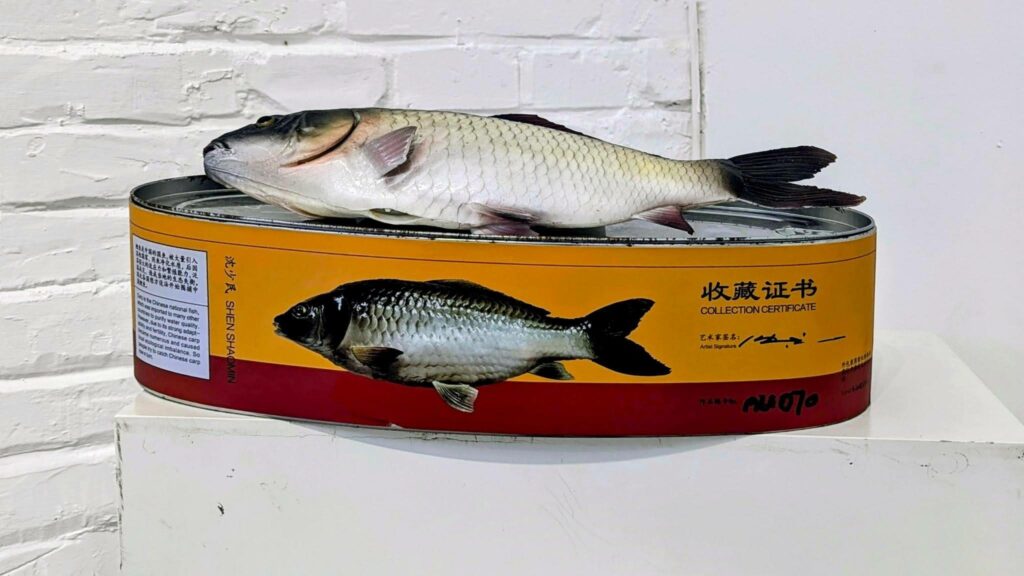
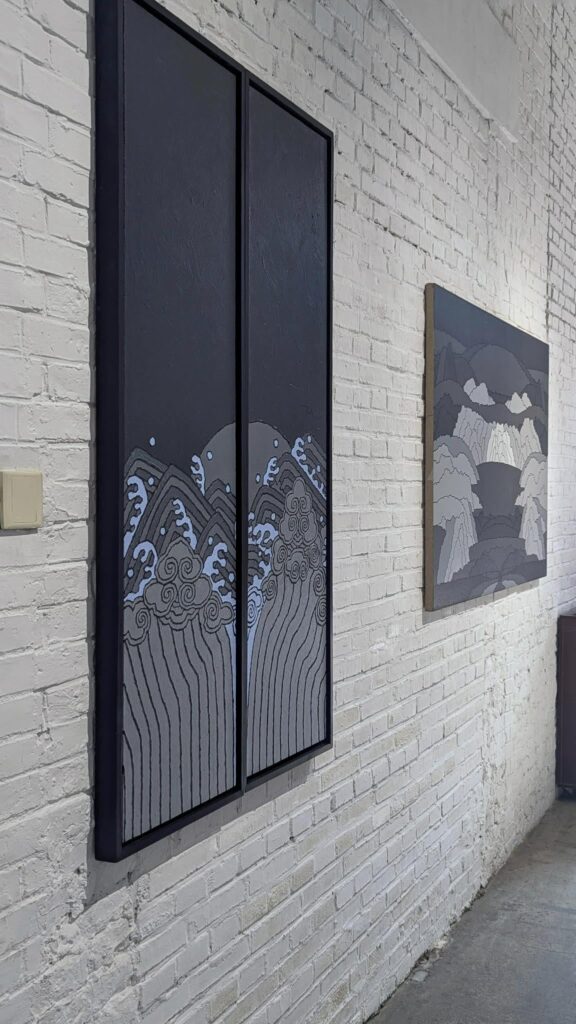
Installation view of Borrowing the Shell, Red Gate Gallery, Beijing, 2026. Works by Zheng Xuewu. Photo: Zhang Guozhong.
About the Author
Hu Chao is an art historian, curator and writer working between China and Southeast Asia. He is a Research Associate Professor at the Research Center for New Art Museum Studies, Guangzhou Academy of Fine Arts. His research explores how images, exhibitions, museums and cross-border artistic exchanges shape understandings of Asia and the modern world. His current projects include the history of artist residencies in China and the movement of Chinese artists across Southeast Asia. He is the author of Constructing National Identity: National Museums and Galleries of Singapore, 1965–2015, published in Chinese, and co-curated Borrowing the Shell: Origins of Artist Residencies in China at Red Gate Gallery, Beijing, with Brian Wallace. His work brings historical research into conversation with curatorial practice and public writing.
Email: huchao.beijing@gmail.com | Website: https://www.huchaocurator.com/